Resolution Rules: Write YES/NO Questions Nobody Disputes
How to write resolution rules before anyone predicts: exact times, named sources, defined terms and cancel conditions, with before-and-after rewrites.

In short
Good resolution rules, written before the market opens, say exactly what counts as YES, by when, according to which source, and when the question is canceled. Use exact times with a time zone, defined terms and a named source, and your friends will rarely argue about the result.
Picture the group chat after the party. The question was "Will Ben be late?" Ben arrived at 8:07 for an 8:00 start, walked in with a bag of ice, and was greeted by two people saying YES and three saying NO. Nobody was wrong. The question was.
Resolution rules are the one or two sentences, written before anyone predicts, that tell everybody exactly what counts as YES, what counts as NO and who decides. This guide is about writing them: the four parts every rule needs, how to make times and fuzzy words exact, which sources to name, and how to decide up front when a question gets canceled. What happens after the event, when someone challenges the result, is a separate skill, covered in how to resolve a prediction fairly once it closes.
What Makes a Resolution Rule Good?
A good resolution rule passes one test: two strangers reading it would resolve the question the same way. A resolution rule is a written statement, attached to a YES/NO question, that defines when it resolves YES and when it resolves NO. Think of it as the referee's rulebook, agreed before the match.
It matters because people read questions differently. "Late" can mean after the start, after the agreed arrival window, or after the last friend sat down. When the outcome is close, each person picks the reading that fits their prediction. That is not dishonesty, it is human nature, and the cure is to remove the ambiguity before anyone has a reason to lean.
Forecasting researchers such as Philip Tetlock describe a similar standard, the "clairvoyance test": a question is clear enough if a hypothetical clairvoyant could answer it without asking you what you meant (see Superforecasting by Tetlock and Gardner). Your friends are the clairvoyants, only they are standing in the group chat arguing.
What Are the Four Parts of a Good Resolution Rule?
Every rule needs the event, the deadline, the source and the fallback.
- The event: exactly what has to happen, in observable terms
- The deadline: a date and time, with the time zone, and whether the deadline itself counts
- The source: who or what confirms the result
- The fallback: what happens if the event is postponed, unclear or impossible to confirm
Here they are in one rule for Ben's question: "Resolves YES if Ben's 'I'm here' message appears in the group chat more than 10 minutes after the 8:00 pm start (after 8:10 pm), according to the chat's timestamp. If the party is postponed, the question is canceled."
Notice that the question ("Will Ben be late?") and the rule agree, and that nothing needs interpreting. Under this rule Ben's 8:07 arrival is a NO, and everyone could have known that in advance.
How Do You Make Dates and Times Exact?
Replace every vague time word with a number, a time zone and a rule for the boundary.
| Vague | Exact |
|---|---|
| This weekend | Between Friday 6:00 pm and Sunday 11:59 pm, host's local time |
| By the end of the month | On or before the last day of the month, 11:59 pm, host's local time |
| In the evening | After 6:00 pm |
| Tonight | Between 8:00 pm and midnight on the night of the party |
Three small details save many arguments. State the time zone whenever friends live in different places. Say whether "before" and "after" include the exact moment named, since "more than 10" and "at least 10" are different questions. And close predictions before the event could be known, so nobody predicts with the answer in hand. KrowdCall markets close automatically at the time you set, which must be at least about 30 minutes ahead and at most 2 years away, and the creator can move it while the market is open.
How Do You Define Words Like "Late", "Big" and "Finished"?
Words that sound obvious are the riskiest, so define each by something you can count, check or see.
| Fuzzy word | Defined |
|---|---|
| Late | More than 10 minutes after the agreed start time |
| Big party | At least 12 guests, as counted by the host at 9:00 pm |
| Finished the book | Tells the group they have read the last page |
| Good weather | Dry and at least 68 F (20 C) at noon, per the host's weather app |
| Popular | More than 50 reactions on the post by Sunday 8:00 pm |
If you catch yourself writing "kind of", "basically" or "roughly", stop and pick a number. A good test is to ask whether someone could prove you wrong with a screenshot. If they could, the term is defined. If it only comes down to opinion, it isn't.
Which Source Should Settle the Question?
Name the source in the rule, and choose one that is timestamped, visible to everyone and not controlled by a player. Strong choices are public records such as an official scoreboard, a published schedule or a weather service, shared messages in the group chat, booking confirmations and receipts, and the count of a named person who isn't predicting.
Avoid three things: memory ("as I recall"), sources that can be edited later, like a draft document anyone can change, and a player confirming their own result when the group has no way to check. When no document exists, name the person instead: "As confirmed by Sam, who is attending the event." That also gives the person resolving a clear fallback, which the guide to resolving predictions builds on when the evidence is messy.
What Does a Rewrite Look Like?
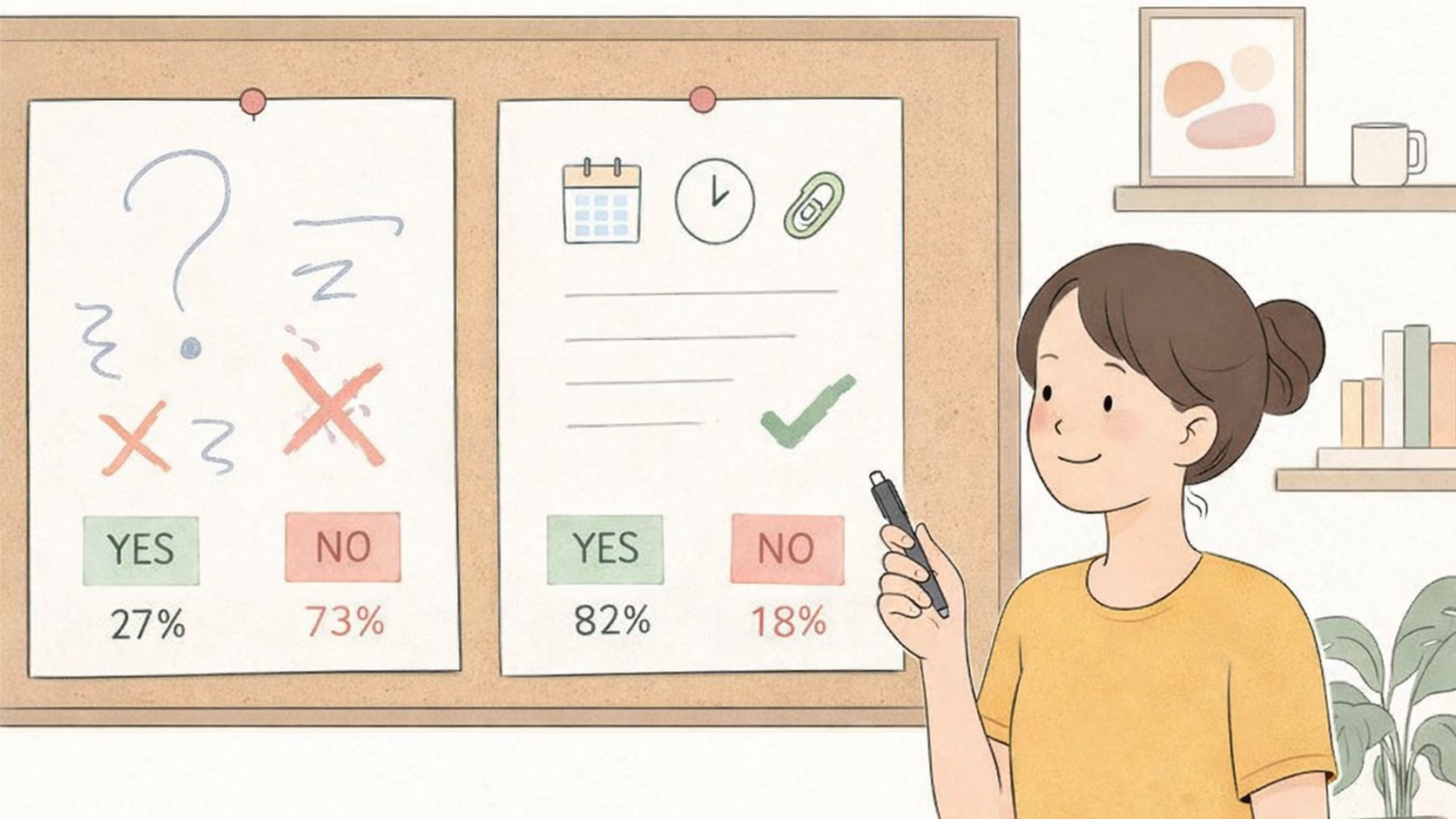
The fastest way to learn this is to rewrite real group-chat questions. Each "after" below has an event, a deadline, a source and, where it matters, a cancel condition.
| Before | After |
|---|---|
| Will we book the trip? | Will at least one friend share a booking confirmation for the group trip in the chat before November 30, 11:59 pm? If the dates change, the question stays open until then. |
| Will it rain at the picnic? | Will the host's weather app show rain at 3:00 pm on picnic day? If the picnic is canceled, the question is canceled. |
| Will Priya finish the 5K? | Will Priya finish the Sunday 5K in under 32 minutes, per the official results page? If she doesn't start, the question is canceled. |
| Will the movie be good? | Will the group's average rating of the film, collected after the credits, be above 7 out of 10? |
| Will the group chat be quiet? | Will the group chat have fewer than 20 messages between Saturday 8:00 am and Sunday 8:00 am, as shown by the chat itself? |
Each question now has a number or a checkable fact, a named place to look, and in two cases an explicit decision about what happens when life interferes. For the question itself, how to choose and word a question people want to predict is the companion piece, and 100 prediction questions about friends gives you plenty to practice on.
When Should a Rule Say the Question Is Canceled?
Write a cancel condition for every situation where a fair YES or NO would be impossible. You can't predict every strange thing, but a handful repeat, and covering the ones that fit your question removes most arguments.
- Postponement: 'If the event is moved past the closing date, the question is canceled.'
- Missing source: 'If the results page is unavailable by the deadline, the question is canceled.'
- Partial results: 'If only part of the group attends, the question resolves on the people present.'
- Equal to the threshold: 'More than 10' and 'at least 10' are different, so choose one and say it
- Multiple events: split 'Will X and Y happen?' into two questions
The last one is the quiet hero. Compound questions create the most disputes, because one half comes true and the other doesn't. Two small questions always beat one clever one. Remember that a cancel condition is a promise, so use it sparingly: it should cover situations nobody controls, not outcomes you'd rather avoid judging.
How Do You Put Rules Into KrowdCall?
Every KrowdCall market has a question, a description and a separate resolution rules field of up to 2,000 characters, so the sentences above have a dedicated place. Put the event and deadline inside the question, and the source, definitions and cancel conditions in the rules.
The detail that matters most: once a market has predictions, the description and rules are locked, so nobody can rewrite them after seeing which way things are going. That is a feature, but it means the time to polish is before you share the market's invite link. If you spot a mistake afterward, cancel the market and create a corrected one, and everyone's Coins come back. How to create a prediction market walks through the form, and the creation page is where you try it.
What Is the Last Check Before You Share?
Read your question to a friend who hasn't seen it, and ask what would make it YES. If their answer matches yours, send it. If they hesitate, the hesitation is where your edge case lives.
A rule does not have to be perfect. It has to be clear enough that the result feels like a fact and not an opinion. And when an argument does start in a group chat, turning the disagreement into a question with a deadline is a good way to make the rule the referee.
Frequently asked questions
Find quick answers to the most common questions about this topic.
Resolution rules are the written conditions that decide whether a YES/NO question resolves YES or NO. They say what counts, by when, according to which source, and what to do in unusual cases. Written before anyone predicts, they prevent arguments afterwards.

Author
BrumaReady to test your predictions?
Put your foresight to the test. Create your first prediction market in seconds — completely free, with no real money involved.