Prediction Market Questions: 9 Writing Tips
Most weak prediction markets fail before the first prediction is made.
The topic is usually fine, and people often care. What breaks is the question. If the wording is vague, subjective, or overly broad, predictors read it differently, the probability ends up mixing several questions at once, and resolution day turns into an argument instead of a clean result.
The good news is that question writing is a learnable skill with a small number of rules. Here are nine of them, from naming the event to deciding when the market should close.
Why the Question Matters So Much
In a prediction market, people aren't just voting for an opinion. They're putting Coins behind YES or NO, and the price reflects what the group collectively expects. That only works if everyone is predicting the same thing.
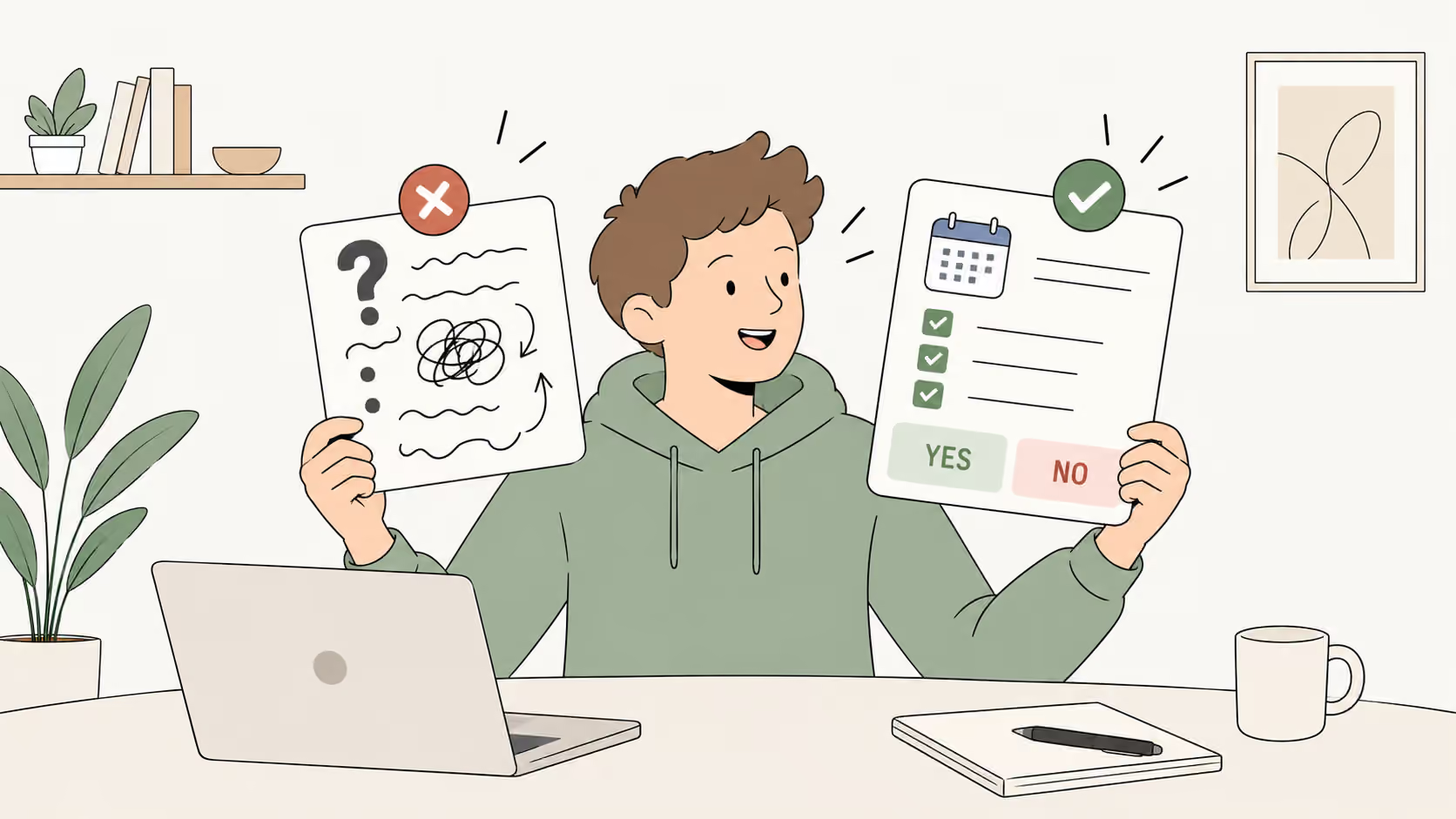
So a question has to do three jobs at once:
- 1It must be easy to understand at a glance
- 2It must be precise enough to resolve without debate
- 3It must be interesting enough that people actually want to make a prediction
In a poll, vague wording is a nuisance. In a market it gets baked into the probability, because people price their own interpretation of the words. Prediction Markets vs Polls covers how the two formats differ and what the research says about their accuracy.
Tip 1: Name One Observable Event
Start with something that either happens or doesn't, in a way people can see.
Will our team play well this weekend? is already a yes-no question, but nobody can agree on what "well" means. Will our team win this weekend? is better, yet it still leaves gaps: which match, and what about a draw?
A fully specified version looks like this:
Will our team beat Northside FC in the league match on Sunday 18 October? (A draw counts as NO.)
Words like good, successful, big, or well feel clear while you're writing them. They fall apart the moment someone asks what they mean. Swap them for an event you could point at.
Tip 2: Add a Deadline
A question should make it obvious by when the event has to happen. Without a deadline, a market is less a forecast and more an open-ended opinion, and it never gives anyone a reason to update.
| Weak question | Stronger question |
|---|---|
| Will the new pedestrian bridge open? | Will the new pedestrian bridge open to the public before 31 March 2027? |
| Will the product launch soon? | Will the product launch before 15 June 2027? |
| Will Giulia finish her thesis? | Will Giulia submit her thesis before the 15 January 2027 deadline? |
Include the year when there's any chance of confusion. "Before June" reads fine today and becomes ambiguous the moment someone opens the market in a different year.
Tip 3: Name the Evidence That Settles It
Even a binary, dated question needs a clear way to decide the result. Will the new restaurant be a hit? fails because hit is a matter of taste. Will the new restaurant have a Google Maps rating of 4.5 or higher on 31 December 2026? works, because anyone can check the same number on the same day.
Before you publish, test the question against the end state, not just the opening hook:
- 1On the deadline, what exact evidence will decide YES or NO?
- 2Would two different predictors read that evidence the same way?
- 3Could the creator resolve this without an argument?
If any answer is no, the wording still needs work. Strong resolution logic builds trust, and trust is what brings people back for the next market.
Tip 4: Keep the Wording Short and Plain
A common mistake is making the question sound smart instead of easy to read. Nobody should need to read a market three times to work out what YES means.
This:
Will the current momentum of the project sustain enough execution quality to hit the next milestone on schedule?
should become this:
Will the project hit its beta milestone by 31 May 2027?
The best questions feel almost boring. That's a good sign: the interest should come from the uncertain outcome, not from decoding the sentence. As a rule, if you can cut words without changing what counts as YES, cut them. Clear wording also invites participation, because people are more willing to make a prediction when they're sure what they're predicting.
Tip 5: Spot the Hidden Assumptions, Then Move Them to the Rules
Some questions look clear but lean on unstated definitions. Take Will the app launch on time? What does on time mean: the original roadmap, the latest one, a public release, a beta?
You could cram every answer into the question, but that makes it long and hard to read. A better split:
- The question names the event and the deadline: Will the app be available in the App Store before 1 June 2027?
- The description explains the context, such as which app and why the date matters
- The resolution rules define the terms, such as 'available means anyone in Italy can download it; a TestFlight beta does not count'
This matters most in team markets, where people assume everyone shares the same context when they often don't.
Tip 6: Use the Resolution Rules for the Edge Cases
On KrowdCall, the resolution rules are a separate field of up to 2,000 characters, and they lock once the first prediction is made. That's where the "what if" questions belong, so nobody has to guess later.
Good rules usually cover:
- The source of truth: the official results page, the venue's announcement, a named data provider
- The timezone, if the deadline is close to midnight or people are in different countries
- Postponement: does a match moved to next week still count, or does the market resolve NO?
- Draws and extra time: in a cup tie, does 'win' mean after 90 minutes or after penalties?
- Cancellation: what happens if the event doesn't take place at all?
You won't predict every twist. But writing down the three or four most likely ones removes most of the arguments that sink a market at the end. If something new does come up, the rules you wrote give you a fair starting point for the call.
Tip 7: Close the Market Before the Answer Leaks
A question can be perfectly worded and still go wrong if the market stays open after the result is visible. If people can still predict once the match has started, the late arrivals aren't forecasting anymore; they're reading the score.
Set the closing time at or before the moment the answer could become known: kickoff for a match, the start of the ceremony for an award, the close of the polling stations for an election. On KrowdCall the closing time has to be at least 30 minutes ahead, and the creator can move it while the market is open, earlier or later. That's useful when a date shifts or something happens sooner than expected.
How to Create a Prediction MarketTip 8: Match the Question to the Audience
A good question for a finance community isn't a good question for a group chat, and the reverse is just as true.
For a private group, the best questions often depend on shared context:
- Will the landlord fix the flat's boiler before 1 November 2026?
- Will Chiara hear back from her final-round interview by 30 October 2026?
- Will our choir be picked for the city's Christmas concert on 12 December 2026, according to the organizers' announcement?
For a public market, the best questions draw on broader interest and data anyone can check:
- Will the ECB cut its deposit facility rate at its December 2026 meeting?
- Will the Met Office record a white Christmas in London on 25 December 2026?
- Will an English club win the 2026–27 UEFA Champions League?
If a question is technically clear but nobody in the audience cares, the market will sit still. If the audience is a closed group, Private Prediction Markets Explained covers when to keep it invite-only.
Tip 9: Pressure-Test Your Wording Against a Better Version
One fast way to improve a question is to write the weak version and the sharp version side by side. If yours looks like the left column, you know what to fix.
| Weak version | Better version | Why the better version works |
|---|---|---|
| Will the bake sale be a success? | Will the school bake sale raise more than €500 on 14 November, per the organizers' count? | Specific threshold, date and source |
| Will the team impress the client? | Will the client sign the contract by Friday 30 October? | Objective outcome |
| Will the season be successful? | Will the club reach the quarter-finals of this season's national cup? | Clear sports milestone |
| Will the video do well? | Will the channel's next video pass 50,000 views within 7 days of release? | Public counter and fixed window |
For a wider set of ready-made ideas by category, see 10 Prediction Market Examples to Try.
A Quick Formula You Can Reuse
If you want a repeatable way to write strong questions, fill in these four parts:
| Part | Template |
|---|---|
| Subject | Who or what is the market about? |
| Outcome | What exact yes/no event is being predicted? |
| Deadline | By when must it happen? |
| Evidence | How will the result be verified? |
For example:
Subject: the next product launch
Outcome: publicly available
Deadline: before 1 July 2027
Evidence: listed live on the company site
Final market question:
Will the next product launch be publicly available before 1 July 2027?
The subject, outcome and deadline go in the question. The evidence, plus any edge cases from Tip 6, go in the resolution rules.
Better Questions, Better Probabilities
A market can only be as clear as the question behind it. When the wording is precise, the price reflects what people actually expect. When it's messy, the price blends several interpretations into one number that means little.
That's why question quality isn't cosmetic. It's part of the market's design, and it's the part you control most directly.
Ready to Write Your First Market?
Pick an outcome people care about, name the event, add a deadline, write down the source and the edge cases, and close it before the answer can leak. How to Create a Prediction Market covers the rest of the setup, and How to Play Prediction Markets With Your Friends shows how to run markets in a group.
Then browse Markets for live examples, and try turning your group chat's next argument into a question everyone can settle.
Frequently asked questions
Find quick answers to the most common questions about this topic.
A good prediction market question is binary, time-bound, and easy to verify. Everyone should understand what YES means, what NO means, and which source will settle the result.

Author
Bruma