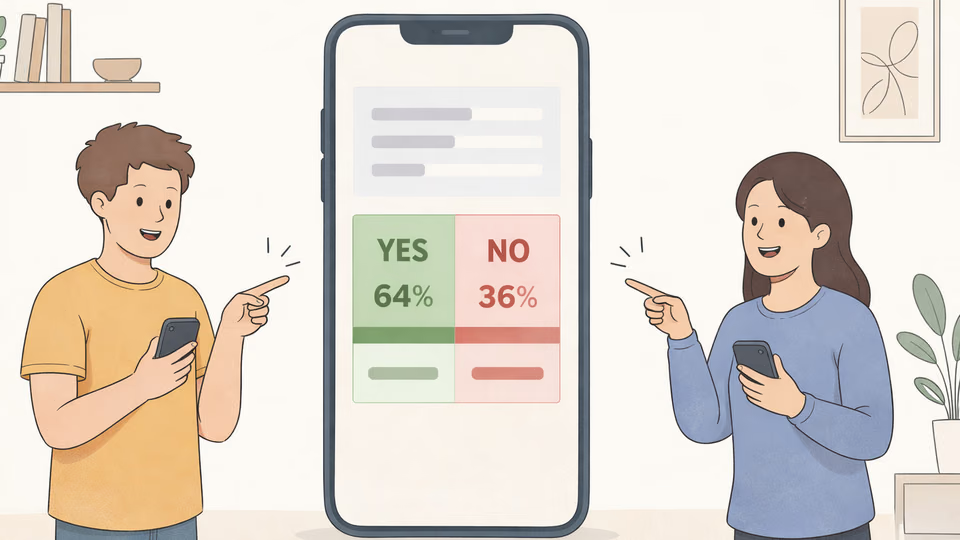
Election Night Party: A Friendly Prediction Game
Host an election night party with a kind, non-partisan prediction game for any country: questions on timing, turnout and counting, plus ground rules.

In short
An election night prediction game works when the questions are about process, not preferences: turnout, when a race is called, how long counting takes. Keep it private, name an official source for every answer, agree on ground rules before the night and let anyone skip any question.
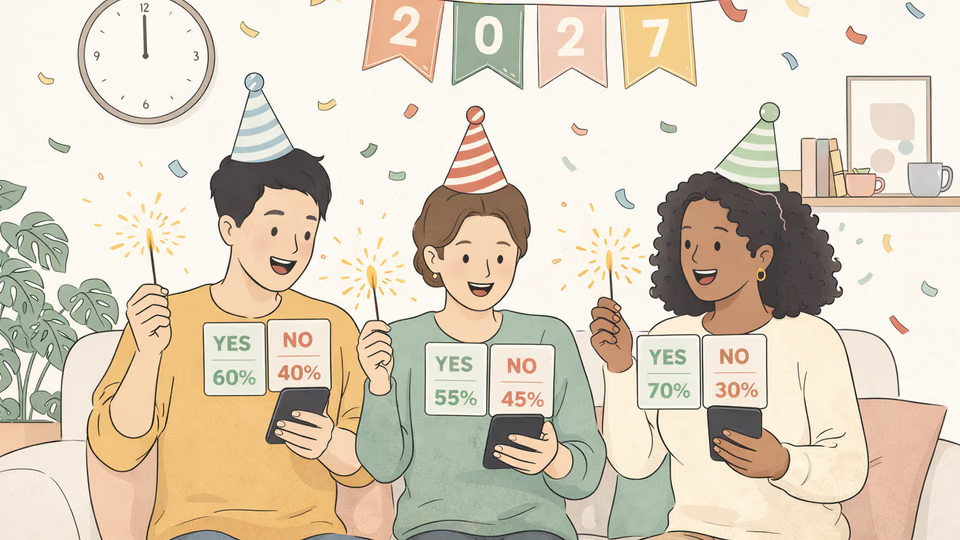
Election nights are strange parties. Everyone is glued to the same screen, the snacks are out, and half the room is quietly anxious about what the map will look like by midnight. If you host one, you probably want an election night prediction game that keeps the evening curious and friendly rather than tense.
The short answer is to predict the process, not the preferences. Ask when a race will be called, how high turnout will be and how long counting will take, and leave out who deserves to win. This guide covers the ground rules, a set of questions that work in any country, and how to pick a resolution source so nobody argues about what "called" means.
Should You Run Predictions on Election Night at All?
It depends on your group. It's a good idea if your friends enjoy the process and the numbers, if the night is mostly social and if people with different views are comfortable in the same room. It's a worse idea if the group is tense, if someone close to you is personally affected by the result or if a prediction might feel like a vote on someone's values.
Ask before you create anything. A quick message does it: "I'm thinking of a light prediction game about timing and turnout. No questions about who should win. Are you in?" If anyone hesitates, make it optional or skip it. The friendly evening is the real goal, and the game is only a tool for it. If you're new to the format, how to host a prediction party covers the basic structure.
What Ground Rules Keep Everyone Comfortable?
Write the rules down and send them with the invitation. It takes two minutes and prevents most problems, including the ones that appear later in the evening.
- Questions are about timing, turnout and process, not about who deserves to win
- Nobody has to predict, and nobody has to explain their reasons or how they voted
- No questions about a named person's private life, health or family
- Anyone can ask to remove a question, and it is removed without discussion
- Anyone can say 'pause the game', and the screen and the scoreboard go off for a while
- The game ends at the hour you announced, even if the count isn't finished
Keep a few things off the table even as jokes: questions that mock a candidate, a party or the voters, predictions about violence, fraud or conspiracies, and anything that turns a result into a personal score against a friend. If someone is upset about a result, skip the leaderboard until tomorrow. And mix in light questions about the party itself so the mood is never only about the count. The unwritten rules for predictions about friends go deeper on consent and kindness.
Which Questions Work for Election Night?
The best questions are measurable, neutral and resolved by a source everybody trusts. Adjust times to your time zone and the races to your own election.
Timing and counting
- Will the first major race be called before 9 pm local time?
- Will [named race] still be uncalled at 8 am the next morning?
- Will the national broadcaster's projection for [race] arrive before the official count reaches 50%?
- Will counting in [district] be completed by 6 am?
Turnout and margins
- Will turnout in our region be higher than at the last comparable election, according to the official authority?
- Will the election authority publish final turnout figures by Friday?
- Will the winning margin in [local race] be under 2 percentage points in the first official count?
Light party questions
- Will anyone at the party fall asleep before 11 pm?
- Will the snacks run out before the first race is called?
- Will a presenter mention a map or chart in the first ten minutes?
Ten questions is already a full night. Questions about who wins are best left out; include one only if the whole group has agreed, and phrase it neutrally with a source.
How Do You Resolve Races Without Arguments?
The biggest risk is a dispute about what counts as "called" or "decided". The fix is to pick one source, name it in the question and write what happens if nothing is declared in time. Sources differ by country, so choose yours before the night.
In the United States, many people use the Associated Press (AP), whose race calls are widely quoted. In a PBS NewsHour explainer, the AP says it calls a race as soon as a clear winner can be determined, that a candidate's victory claim doesn't trigger a call, and that it doesn't make projections. It labels some races "too early to call" or "too close to call" when no clear winner has emerged.
Elsewhere, the source is usually one of three things. A national or regional election authority publishes official results, often constituency by constituency. A public broadcaster publishes projections based on exit polls or partial counts. And some countries count overnight while others take days, so a "result" can be provisional first and certified later. In your question, say which one you mean: "according to authority's published results" is not the same as "according to broadcaster's projection".
| Vague | Resolvable |
|---|---|
| Will the race be decided early? | Will [named source] declare a winner in [race] before 10 pm local time? Resolves NO if no call is made by then. |
| Will turnout be big? | Will turnout in [district] exceed 62%, according to the official results published by [authority] by Friday 6 pm? |
| Will it be close? | Will the winning margin in [local race] be under 2 percentage points in the first official count? |
The phrases "according to" and "by time" do most of the work. Don't plan a night question if the result will only be known next week; set a closing time that is realistic, and be ready to cancel if the data never arrives. How to write resolution rules has more before-and-after examples, and how to resolve a prediction fairly helps if a friend challenges your call.
How Do You Run It on KrowdCall?
Create each question as a private market in the Politics category, with the source and the time in the resolution rule, and share the invite link in the group chat. Guests open it, sign in with Google in a few seconds and join at once, and only people with the link can see the questions. If it ends up somewhere it shouldn't, reset it in the share dialog.
Check the wording carefully before you share: once a market has predictions, its rules can't be edited. Set the closing time with some slack; the creator can move it later if the schedule shifts. Then resolve each question with a short note naming the source. For a small party the probabilities will mostly reflect your friends' hunches, which is fine for a game about process, and the Players count on each market shows how many people have predicted. Create the first question when you're ready.
What Makes the Night Work?
The question isn't really whether to predict the election, it's whether the game helps the room. Keep the questions about the process, the rules gentle and the prize silly, and it gives people something to do between results and a way to talk about the evening that has nothing to do with winning arguments. For other occasions, prediction game ideas for every occasion has formats to try. And if the night goes badly, there is always tomorrow's brunch.
Frequently asked questions
Find quick answers to the most common questions about this topic.
It is a watch-party game where friends answer YES/NO questions about how the night will unfold, such as turnout, when a race is called or how long counting takes, then see who called it. It is for fun and bragging rights, and it is explicitly not a place to argue about who should win.

Author
BrumaReady to test your predictions?
Put your foresight to the test. Create your first prediction market in seconds — completely free, with no real money involved.