How to Host a Prediction Party: Step-by-Step
How to host a prediction party: pick an event, share the invite links, then follow a full example evening with timeline, 8 questions and closing times.

In short
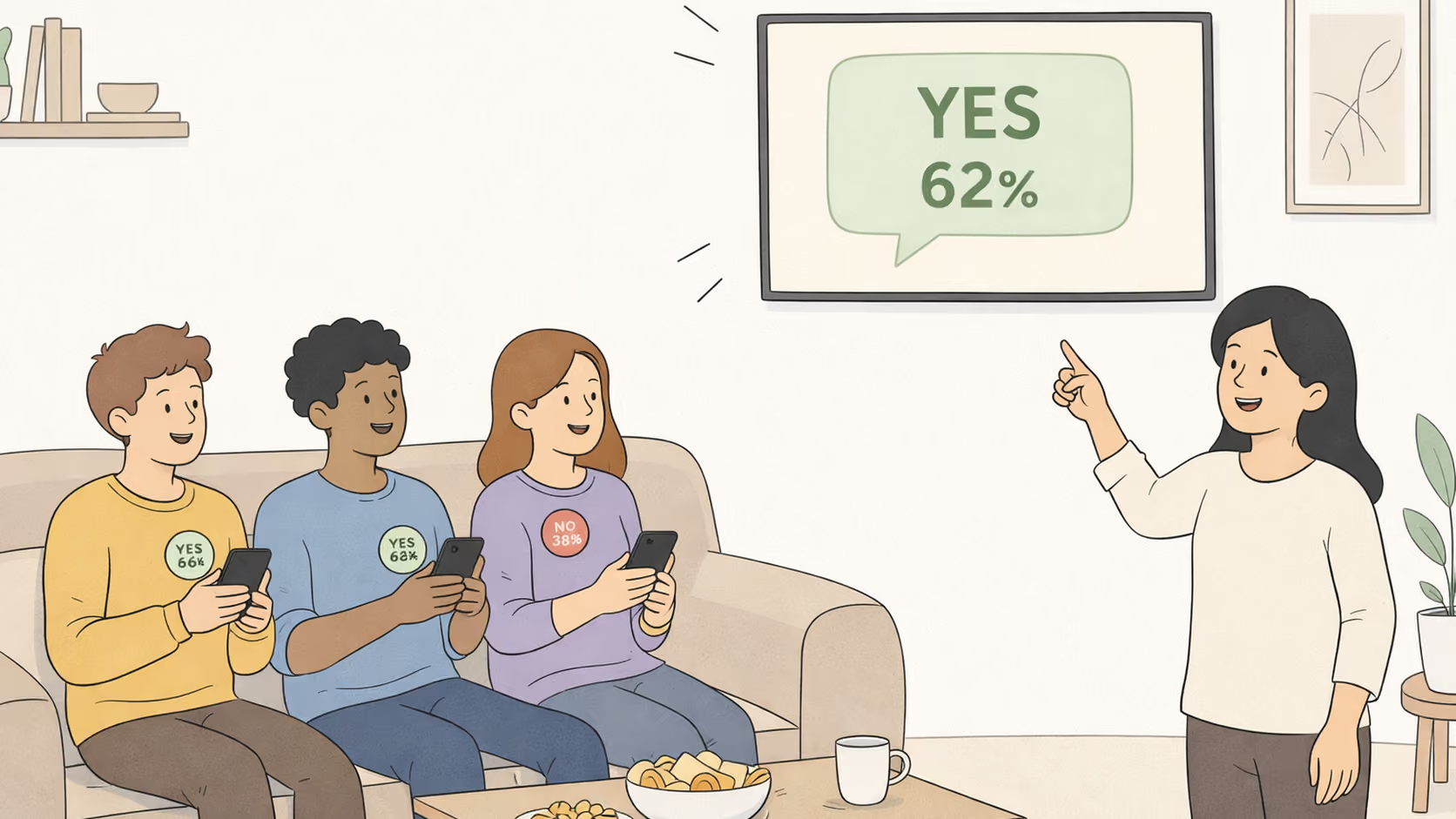
To host a prediction party, pick one event with a fixed start, write 6 to 10 YES/NO questions you can settle on the night, share private invite links a few days early, close predictions just before each moment and resolve live. Crown the best caller with bragging rights.
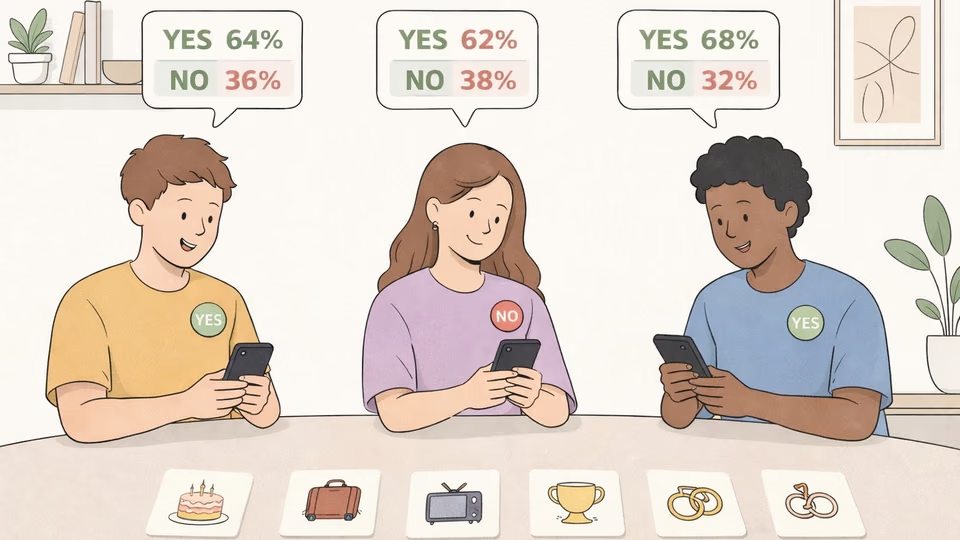
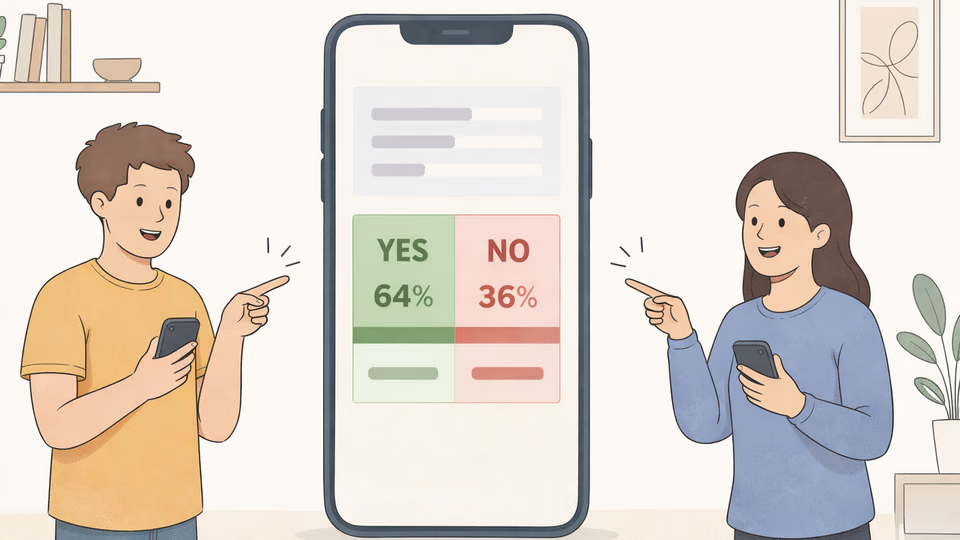
Most parties have a moment when everyone is guessing at something: who will win, how long the speech will run, whether the cake survives the trip. A prediction party gives that guessing a shape. Guests answer a handful of YES/NO questions before the big moment, watch the group's view build on their phones, and find out together who called it.
This guide shows how to host one: choose the event, write the questions, send the invite, set closing times, resolve live and pick a winner. Partway down there is a complete example evening, with a timeline, eight questions, when each one closes and how each is settled, that you can copy for your own night.
What Is a Prediction Party, and Which Events Suit It?
A prediction party is a gathering where predictions are the side show to a main event. The event comes first, and the questions give everyone a reason to notice details they would otherwise miss.
The event needs a fixed start time and a visible result. It works best when there are real surprises, when most answers arrive during the evening so you can resolve before people go home, and when your guests already enjoy teasing each other kindly. It works less well for events with nothing uncertain in them, or for groups that get tense when someone loses; for that crowd, keep the questions silly and the competition light. "Sometime this year" isn't a party, it's a long-running challenge.
Here is how to match the event to a guide:
- Television and music nights: a series finale night, a reality show watch party, an awards ceremony or the Eurovision final.
- Sports and big nights: the Super Bowl or an election night with friends.
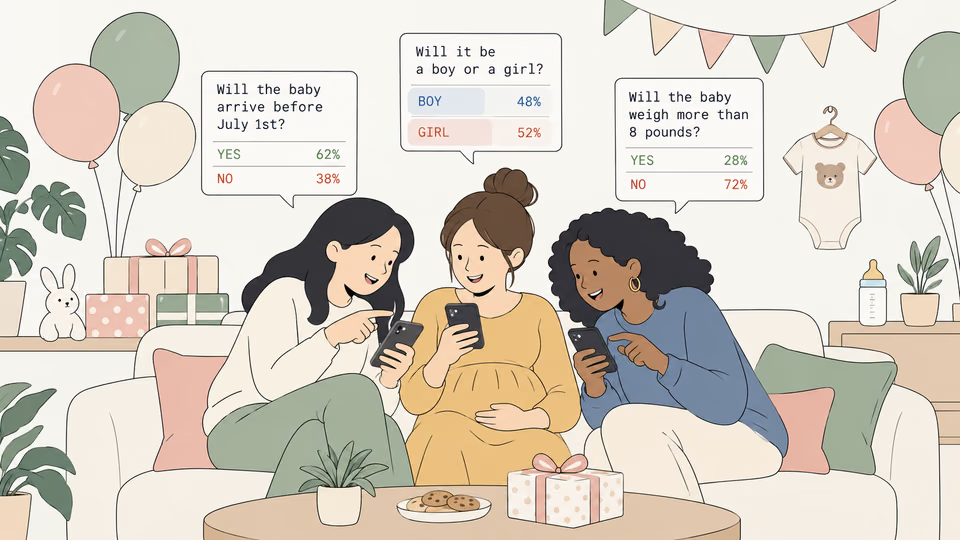
- Personal milestones: a birthday party, a baby shower or a class reunion.
- Quieter evenings: prediction challenges added to a game night.
Still hunting for an occasion? 25 prediction game ideas by occasion covers the rest of the calendar.
What Does a Whole Prediction Party Look Like?
Here is one complete evening: a Sunday series finale that starts at 9 pm. Swap in your own show or match and the structure holds.
The timeline
| Time | What happens |
|---|---|
| Four days before | The host creates all eight questions, with closing times and proof written in |
| Three days before | The invite links go out in the group chat in one message; guests sign in with Google and join |
| 7:30 pm | Doors open, snacks out, guests glance at the questions |
| 7:55 pm | The two arrival warm-ups close and the host resolves them |
| 8:55 pm | The six episode questions close, just before the show starts |
| 9:10 pm | The host resolves the first-ten-minutes question live |
| 10:30 pm | Credits roll; the host resolves the rest, one by one, reading each proof aloud |
| 10:45 pm | Scoreboard, crown, plans for next time |
The eight questions
| Question | Closes | How it's settled |
|---|---|---|
| Will at least 6 guests arrive before 8 pm? | 7:55 pm | The host's head count at 8:00 pm |
| Will the pizza be gone before 9:30 pm? | 8:30 pm | The host posts a photo of the empty box |
| Will [character] appear in the first 10 minutes? | 8:55 pm | Watched live; the host resolves at 9:10 pm |
| Will [character] survive the finale? | 8:55 pm | Resolved when the credits roll |
| Will there be a scene after the credits? | 8:55 pm | Anyone still watching confirms to the host |
| Will the final scene take place in [the show's first location]? | 8:55 pm | The host resolves at the final scene |
| Will the final line be spoken by [character]? | 8:55 pm | The host resolves at the final scene |
| Will the credits start before 10:45 pm? | 8:55 pm | The host's clock when the credits begin |
Notice the mix. The first two are warm-ups that resolve early and teach everyone how the evening works. The next four are the main event, and two of them (the survival question and the final location) are ones a room will genuinely disagree about, which produces the best chat. The last two are the finale: they resolve last and keep people on the sofa. Every question has a deadline and a proof the host can verify in person, which is what makes live resolution painless. To write your own, how to word a question nobody can argue with has more before-and-after examples.
How Do You Invite Guests and Set Up the Questions?
Create each question as a private market, then share the invite links a few days early, all in one message in the group chat. Markets on KrowdCall are private by default: only people you invite can see and predict. Each market has its own invite link, which the creator copies, shows its QR code or uses the phone's share sheet, and can also invite people by username, up to 100 per market. Friends who open the link sign in with Google, which takes new players a few seconds, and join at once. If the link lands somewhere it shouldn't, reset it in the share dialog and the old one stops working immediately.
Put these in the invitation message:
- What the event is and when it starts
- That it's free, with no money involved
- One line of instruction: tap the link, sign in with Google, you start with 1,000 free Coins
- That predicting is optional and can also be done at the party
Early invitations get sign-ins out of the way, so you don't spend the first half hour helping a guest find their Google account. A user can create up to 10 new markets per 24 hours, so an eight-question party fits in a day; for a bigger one, spread the creating over two days. For the mechanics, how private markets decide who can see and join has the details, and the market creation form is where you start.
When Should Predictions Close?
Close each question just before the moment it is about. A question about the opening scene closes before the show starts; a question about the final result closes shortly before the final begins. KrowdCall closes a market automatically at its closing time, and after that nobody can predict.
The closing time has to be at least about 30 minutes ahead when you create the question, so create them days ahead, when you send the invitations, not five minutes before kickoff. If the schedule slips, the host can change the closing time while the market is still open, as long as the new time is again at least 30 minutes away. A closed market can't be reopened, so give yourself a margin, especially for events that might start late.
How Do You Resolve Questions Live Without a Fight?
Appoint one resolver, usually the host, and write the proof into every question beforehand. Resolving live is the best part of the evening, because the room reacts together, and it is where a party goes wrong if you wing it.
When a question closes and the answer is clear, resolve it YES or NO and add a short note, such as the timestamp. If the answer is genuinely unclear, say so, check the evidence together and decide before moving on. If something makes a question meaningless, like a canceled event or a changed rule, cancel it instead of forcing an answer: everyone gets back what they put in. Once a market has predictions, its description and resolution rules can't be edited, which is fair, because nobody can quietly change the rules after seeing what happened. What to do about ties, disputes and unclear answers covers the hard cases. On a party night you will resolve long before KrowdCall's 7-day automatic cancellation matters.
How Do You Pick a Winner and a Prize?
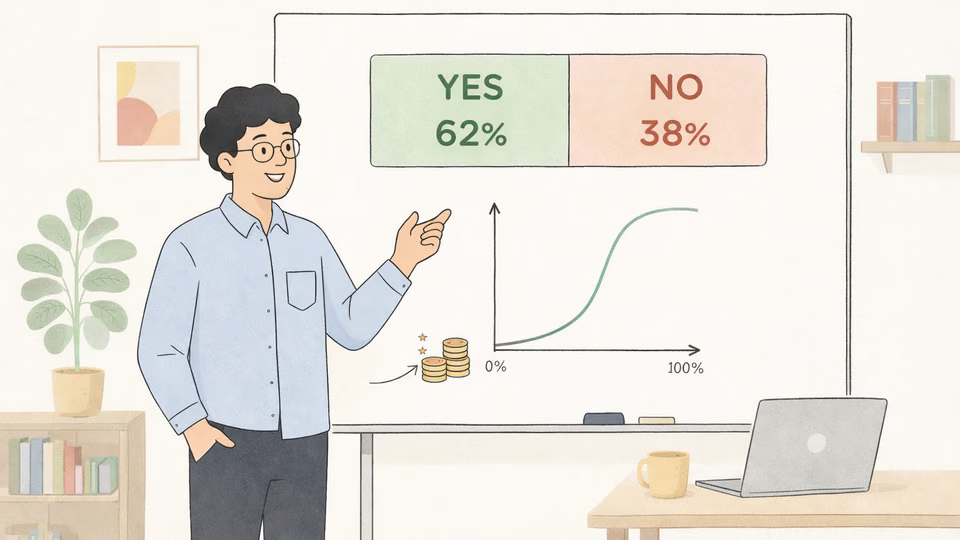
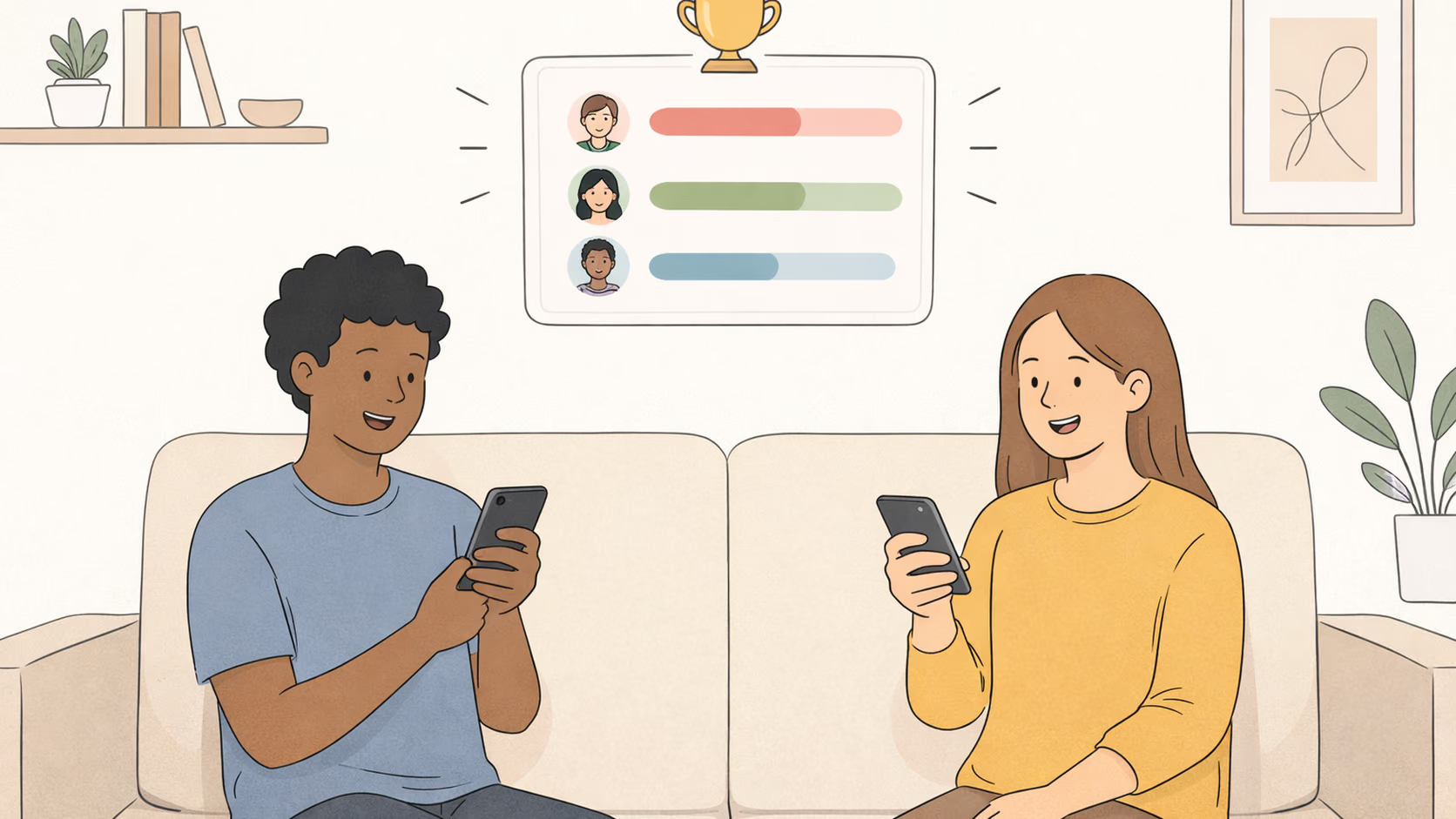
Compare results on the party questions only. A guest's total Coin balance includes everything they have played on KrowdCall, not just your party, so it is not a fair party score. Use each guest's profit and loss page, which lists settled results, or keep a quick scoreboard on a whiteboard or in the group chat. For a small party the whiteboard is often the better choice, because everyone can see it fill up.
Then pick a prize that costs nothing: a paper crown or silly trophy that moves to the next winner, the right to choose next month's event, a title for the group chat name such as "Oracle of the Season", or first choice of dessert. Skip any prize that involves paying or collecting from guests. Why friendly competition works without money explains why bragging rights are enough.
What Can Go Wrong on the Night?
A few problems come up often enough to plan for.
A guest isn't comfortable with a question. Cut it, no discussion. A question about a guest should be fine with that guest, and the etiquette of predicting about real people lists what's off-limits.
An answer is disputed. Go back to the written proof. If it settles the matter, resolve. If it truly doesn't, cancel the question and tighten the wording next time.
One person keeps winning. That's a game for you. If others lose interest, rotate the host and the question writer, or make the next round about something the leader knows nothing about.
The event is postponed. Move the closing times if the markets are still open, or cancel them and recreate them for the new date.
What Should You Do the Day After?
Post the final result in the group chat, celebrate the winner and ask what people want to predict next. The best prediction parties turn into a tradition, one event at a time. Start with a single event, a handful of clear questions and a host who resolves with a note; once your friends have shown you what they enjoy, the next one can be a little more ambitious.
Frequently asked questions
Find quick answers to the most common questions about this topic.
A prediction party is a get-together built around an event, such as a finale, a ceremony or a birthday, where guests answer YES/NO questions about what will happen before it happens. As the event unfolds, the host resolves the questions and the group sees who called it best.

Author
BrumaReady to test your predictions?
Put your foresight to the test. Create your first prediction market in seconds — completely free, with no real money involved.