Family Holiday Games: Prediction Fun for All Ages
Family holiday games for the whole table: 12 kind yes/no predictions for kids and grandparents alike, plus paper cards for anyone without a phone.

In short
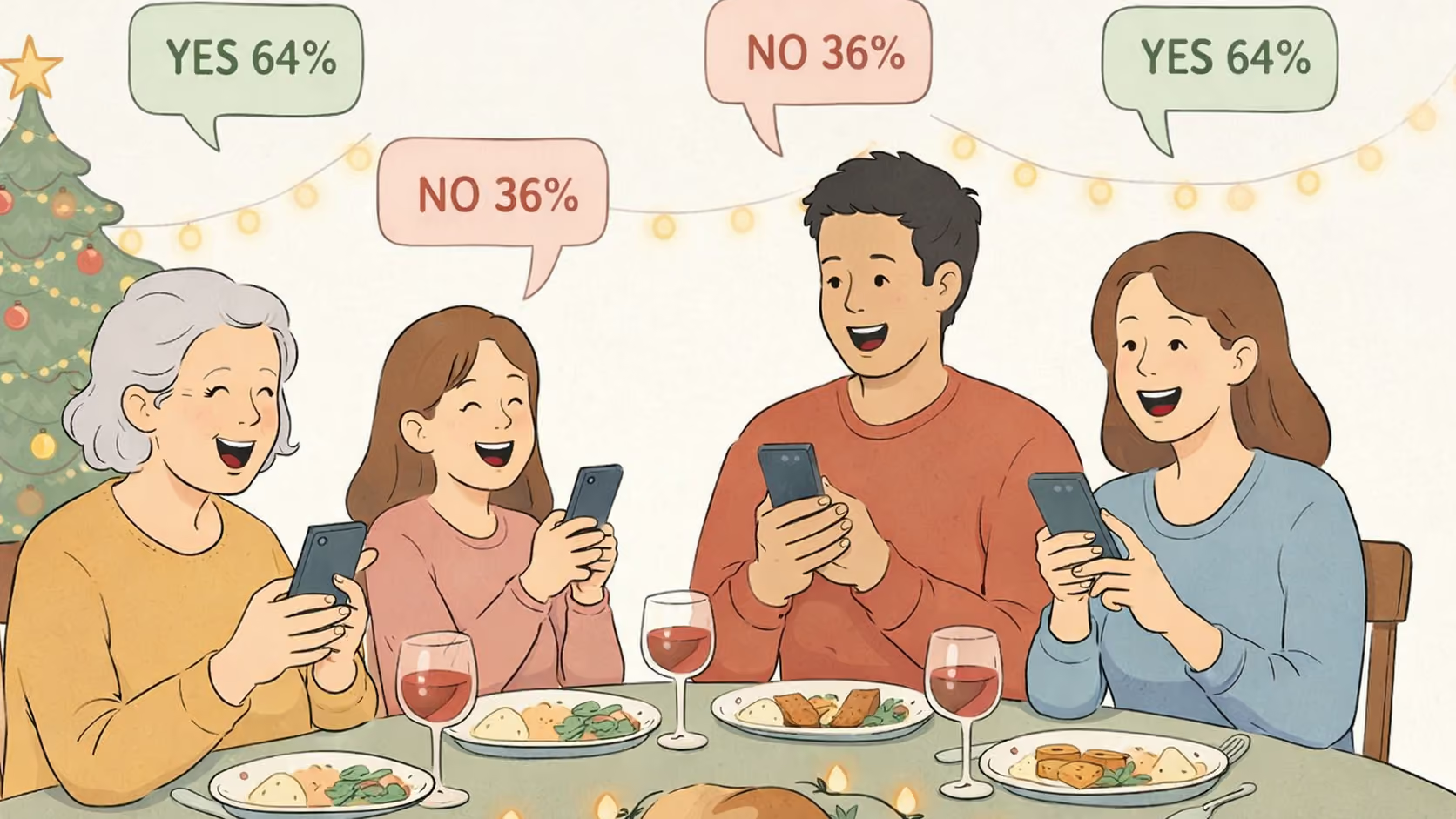
A prediction game is an easy family holiday game: everyone from kids to grandparents calls small, happy moments of the gathering as yes/no questions. Play in rounds by age, put paper cards next to the phones, keep sensitive family topics off the table, and let one adult host.
Every family holiday has its own small predictions that nobody writes down. Will Grandpa fall asleep before dessert? Will dinner really start at five? Will the youngest cousin find the hidden present first? A family holiday prediction game gives those hunches a home: a handful of yes/no questions about the day, one set of answers at the end, and some friendly bragging across three generations.
The challenge with family games is the age range, not the rules. A game that works for a seven-year-old and an eighty-seven-year-old has to need no skill and no screen. This guide shows how to play in rounds by age, how to include people without a phone, and 12 questions that stay light enough for any table, whether the occasion is Thanksgiving, Christmas, Hanukkah, Eid, Diwali, Lunar New Year or just a big Sunday lunch.
Why Do Prediction Games Suit a Table of Mixed Ages?
Because the core action is just looking at a question and saying YES or NO. A board game is too slow for the kids, a video game leaves the grandparents out, and charades makes the teenagers vanish. Everyone understands a yes/no question, it needs no teams or props, and the questions are about shared traditions, so every generation has an opinion.
It also runs in the background, so people can dip in and out between courses. The honest limit is that it isn't a showpiece. Keep it optional and let anyone who would rather chat simply chat.
What Should You Keep Off the Menu?
Anything with history. Family gatherings carry tender spots, and a mild question can land badly if one of them is nearby. Keep the questions about the day: timing, food, weather, games and traditions. Leave out politics and religion, health, age and weight, relationships and plans to marry or have children, money and jobs, and anything about a relative who isn't present or has had a hard year. A good test is whether you'd say the question out loud to the whole family with the host standing next to you. The unwritten rules for predictions about friends apply to relatives too, with extra care.
Which 12 Questions Work for a Family Holiday Prediction Game?
Choose six to eight and add a family joke or two. Each question has a clear YES or NO, and the host settles it from what they see. All close before the moment they ask about, so nobody predicts with the answer already in view.
| Round | Question | Settled by |
|---|---|---|
| The meal | 1. Will dinner be served within 30 minutes of the planned time? | The host's watch |
| The meal | 2. Will anyone ask for a second helping of dessert? | The host's notes |
| The meal | 3. Will the dishes be done by 9 pm? | The host's watch |
| Traditions | 4. Will the family sing at least one song together before dessert? | The host's notes |
| Traditions | 5. Will we watch the same film or special we watch every year? | The host's notes |
| Traditions | 6. Will we take the annual group photo before dark? | The photo's timestamp |
| Kids' round | 7. Will the dog or cat steal something from the table? | Anyone's witness, noted by the host |
| Kids' round | 8. Will it snow or rain before bedtime? | The host's window |
| Grandparents' round | 9. Will a grandparent tell a story from when they were young? | The host's notes |
| Grandparents' round | 10. Will the grandparents win the family card game? | The score sheet |
| Whole family | 11. Will we play a family game before the evening ends? | The host's notes |
| Whole family | 12. Will we agree on a date for next year's gathering before we leave? | The host's notes |
If you want to adapt more of them, prediction questions about friends works just as well for relatives.
How Do You Include Grandparents, Kids and Faraway Relatives?
Match the way each person plays to what they're comfortable with. Sign-in is the only technical hurdle, and paper solves it.
| Who | How they play |
|---|---|
| Grandparents | A paper card with the questions, plus a phone buddy who enters their calls and reads out the results |
| Young children | A paper card, or a parent's phone. Google sign-in has its own age rules, so check what your family's accounts allow |
| Teenagers | Give them the job of host or resolver, which turns a phone into a responsibility |
| Relatives far away | Send the invite link early so they can sign in with Google and join from home |
Pick one adult as host. They create the questions, keep the phone and resolve the answers, since only the creator of a market can resolve it. Games for friends in different cities has more ideas for including people who can't be at the table.
How Does It Run on KrowdCall?
A few days before, the host creates each question as a private market, writes each rule precisely, such as "Resolves YES if dinner is served within 30 minutes of 5 pm, as noted by the host," and shares the invite link in the family chat. Relatives open it, sign in with Google and join at once, and nobody outside the family can see the questions. If the link spreads somewhere it shouldn't, the host resets it in the share dialog.
Print the questions and pin them to the fridge with their closing times, so nobody has to scroll. After dinner, the host resolves each market with a short note; they have 7 days after a closing time before the market is canceled and Coins are returned. The free virtual Coins can't be bought or sold, so the family champion earns a title such as "The Family Weatherperson" and the right to choose the next carol or the last piece of pie. How to host a prediction party covers hosting any gathering step by step.
Can the Game Last Beyond the Holiday?
Yes, and this is where it becomes a family tradition. Keep a few questions open until the next gathering, such as "Will the whole family be together again next summer?" or "Will the new puppy learn to sit by spring?", and resolve them over the next meal. A market can close up to two years ahead, so "calling the year" over a festive table is easy to keep. Birthday party games for adults uses the same two-clock idea for a single person's year.
The best result for a family holiday game is a small one: someone saying, "Wait, I thought Grandma would win," and the whole table turning to look at Grandma. If that happens, the game did its job, and it needed no more than a question and a pencil.
Frequently asked questions
Find quick answers to the most common questions about this topic.
Prediction games work well because the questions are simple yes/no calls about the day, such as whether dinner starts on time or someone sings before dessert. Kids, parents and grandparents can all play, and nobody needs special skills or props.

Author
BrumaReady to test your predictions?
Put your foresight to the test. Create your first prediction market in seconds — completely free, with no real money involved.