Wisdom of the Crowd: Why Groups Often Predict Better
Wisdom of the crowd explained: Galton's ox, the four conditions a crowd needs, how crowds fail, and how to use your friend group to make better forecasts.
- Author
 Bruma
- Published
- Reading time
- 7 min
- Category
- Explainers
In short
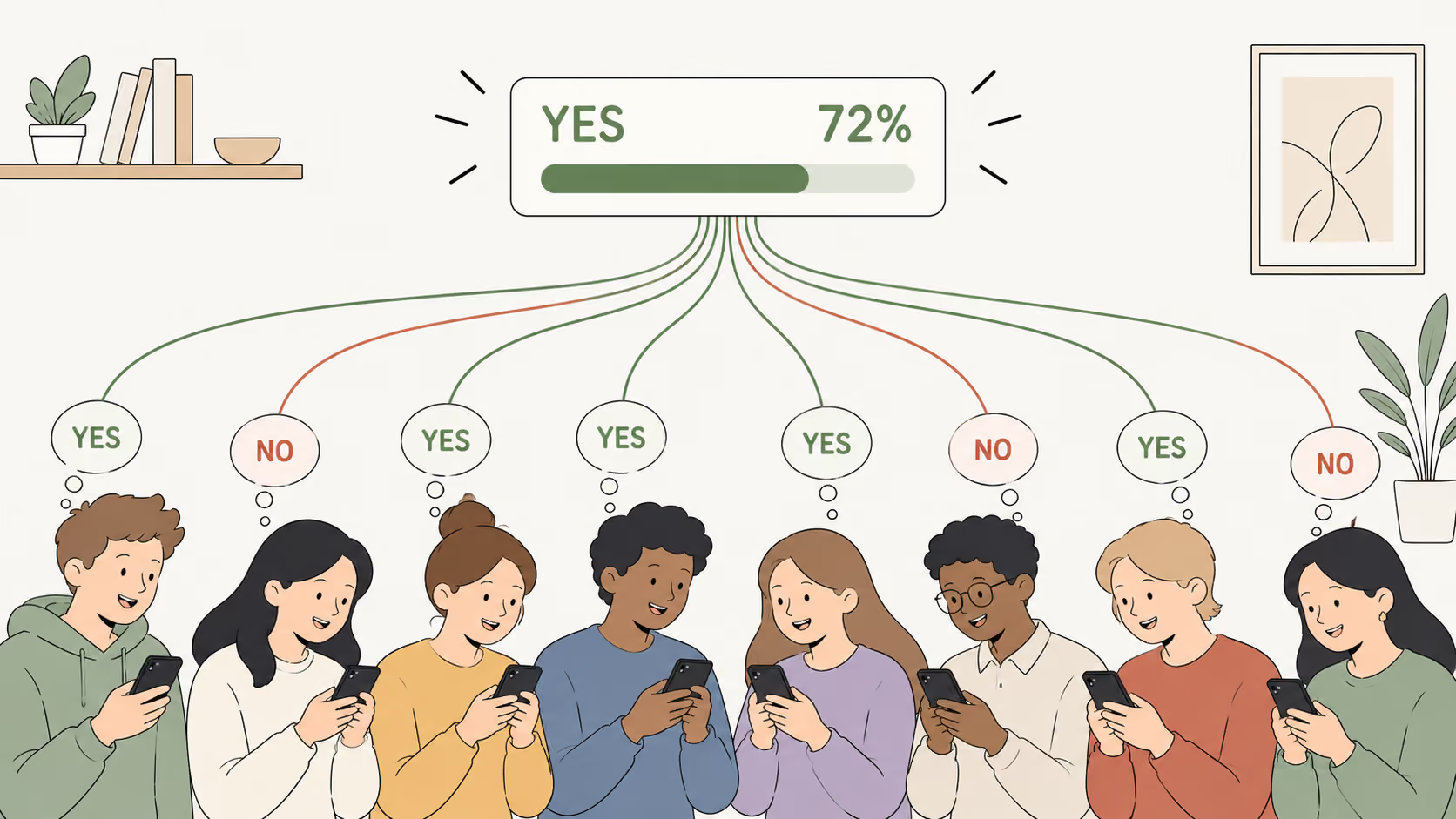
The wisdom of the crowd is the finding that the combined judgment of many people is often more accurate than most individuals in the group. It works when people hold diverse views, judge independently, use local knowledge and have a way to aggregate answers. It fails when they herd.
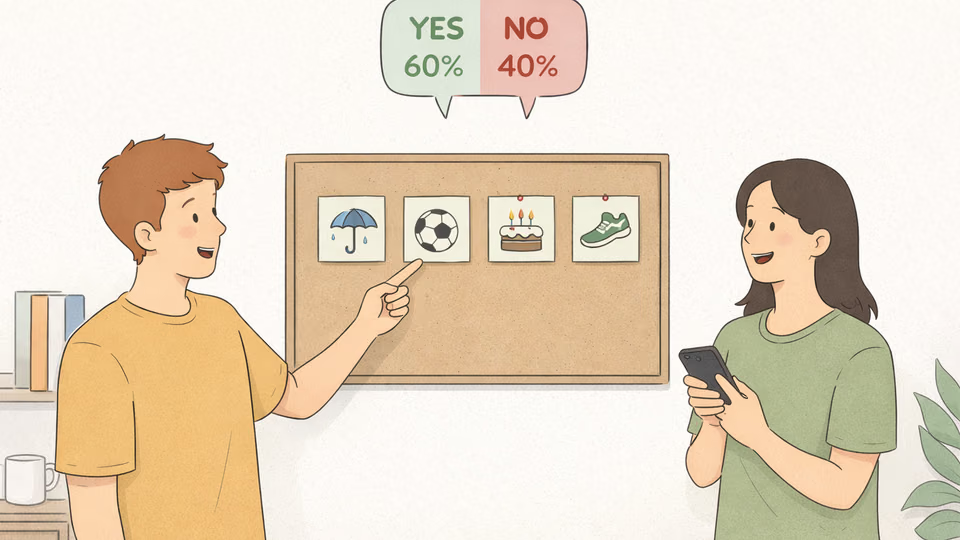
Imagine five friends trying to guess how many people will show up to Saturday's barbecue. One says 20, one says 35, one says 28, one says 50, and one says 15. Whose guess should you trust?
Maybe none of them. Maybe all of them together. The wisdom of the crowd is the finding that the combined judgment of many people is often more accurate than most of the individuals who produced it. It sounds like a party trick, but it has more than a century of research behind it, and it is the idea underneath every prediction market. This post covers where it comes from, what a crowd needs in order to be wise, how crowds go wrong, and how to build a small one with your friends.
What Is the Wisdom of the Crowd?
The wisdom of the crowd is the idea that, for the right kinds of questions, the average or median of many independent estimates tends to land closer to the truth than most individual estimates.
Here is why that works. Each person's guess is the truth plus an error. Some errors are too high, some too low. If the errors are independent, they partly cancel when you combine the guesses, and what's left is closer to the truth.
A tiny example. Suppose the real answer is 1,000 and five people guess 800, 1,200, 1,500, 600, and 1,100. Their individual misses are 200, 200, 500, 400, and 100, an average miss of 280. The five guesses add up to 5,200, so their average is 1,040, which is off by only 40. In this example the group's average beat every one of the five individuals, and it did so without anyone knowing in advance who was right.
That is a lucky example, and it's worth being honest about what is guaranteed. The average of the guesses can never be farther from the truth than the typical individual's miss (here, 280), and it usually does much better because errors in opposite directions cancel. It beating the very best individual is a bonus, not a rule.
The important phrase in the definition is "the right kinds of questions." We'll get to that.
What Was Galton's Ox Experiment?
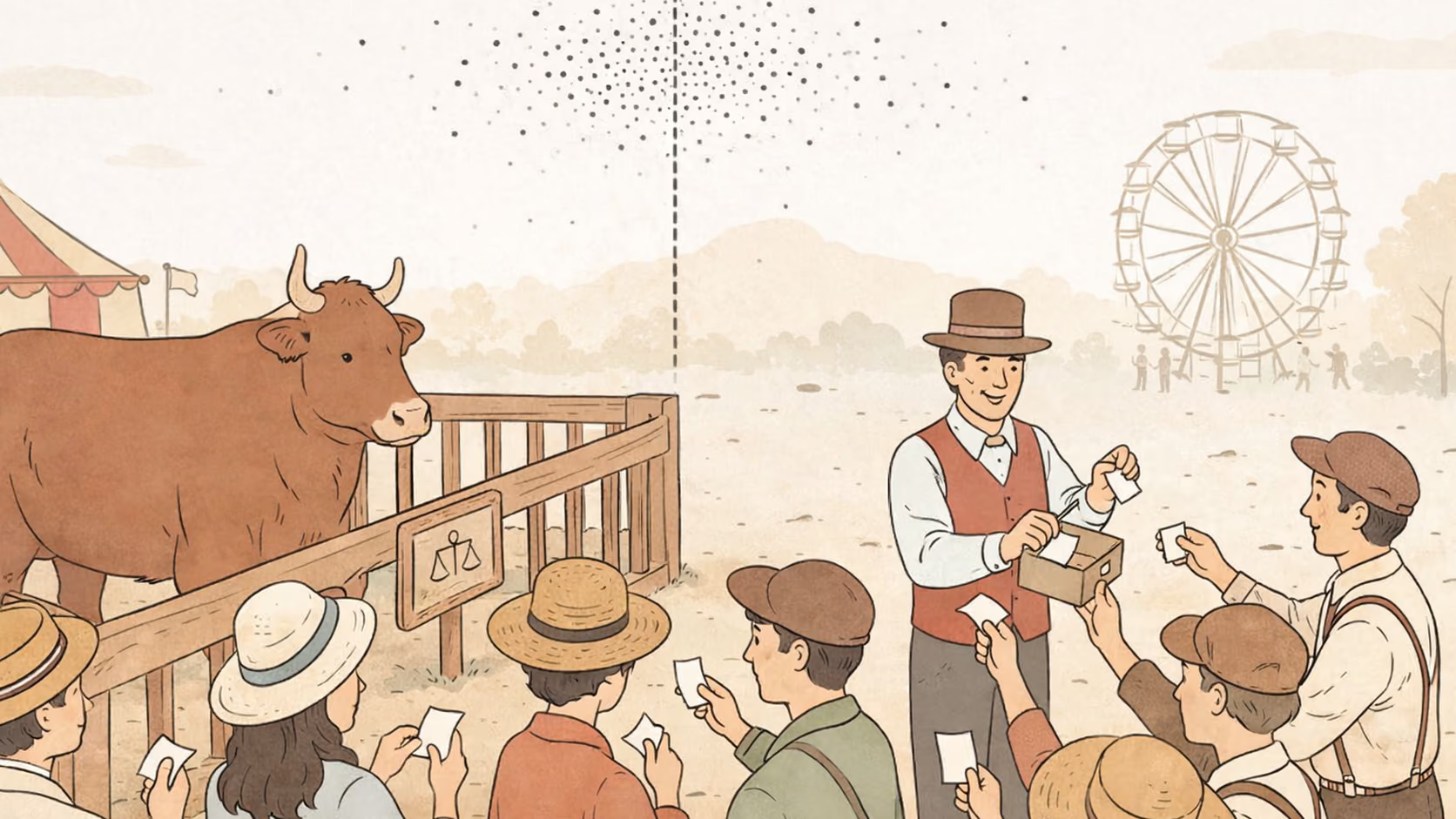
The most famous story comes from the English polymath Francis Galton, who reported it in a short letter to Nature titled "Vox Populi", published in 1907.
The setting was a livestock fair in Plymouth, England, in 1906. Visitors competed to guess the weight of an ox after it had been slaughtered and dressed. According to Galton's account, 787 usable entries remained. He took the middle value, the median, and found it was 1,207 pounds. The dressed ox weighed 1,198 pounds, so the crowd's middle guess was within about 1% of the real figure.
A small honesty note: the statistician Kenneth Wallis went back to Galton's data and found small discrepancies in the numbers, which he discusses in "Revisiting Francis Galton's Forecasting Competition". The conclusion doesn't change: the crowd's middle estimate was remarkably close.
The story also shows why the choice of method matters. The mean uses every guess equally, so one wild answer can pull it a long way. The median only cares about the order, so a few absurd answers hardly move it. A market price behaves differently again, because it moves most when someone is willing to back a view, so confident people count more than shrugging ones. None of these is always best, but pick your method before you see the guesses, so you can't be tempted to choose the one that flatters your favorite answer.
What Did Surowiecki Add in "The Wisdom of Crowds"?
For most of a century, Galton's story was a curiosity. In 2004, the journalist James Surowiecki published The Wisdom of Crowds (Doubleday), opened with the ox story, and argued that the effect shows up in markets, juries, and search engines. He also listed four things a crowd needs in order to be wise:
| Condition | What it means | Friend-group example |
|---|---|---|
| Diversity of opinion | Each person has some private information or a different way of reading known facts | Invite the cousin who follows football and the one who knows nothing, not just the five biggest fans |
| Independence | People's views are not shaped by those around them | Everyone commits a guess before seeing the others |
| Decentralization | People specialize and draw on local knowledge | The person who lives near the venue knows about the road closure |
| Aggregation | A mechanism turns individual judgments into one answer | A median, an average, or a market price |
Each condition is a failure waiting to happen if it is missing. No diversity, and everyone makes the same mistake. No independence, and one early opinion drags the rest. No decentralization, and nobody has local facts. No aggregation, and you just have a pile of opinions.
When Does the Wisdom of the Crowd Fail?
Okay, but crowds aren't always wise. Three failure modes cover most cases.
Herding
Herding is when people copy what others are doing instead of using their own information. In a 2011 experiment, Jan Lorenz and colleagues had 144 participants answer factual questions. When people could see others' estimates, the diversity of opinions shrank and the group grew more confident without getting more accurate. Even mild social influence was enough to damage the effect (Lorenz et al., PNAS, 2011).
That result has a counterpoint: a later experiment found that in decentralized networks, where no one voice dominates, social influence can actually improve accuracy (Becker, Brackbill and Centola, PNAS, 2017). So the careful reading is that influence can hurt, and that the structure of who sees what matters.
Bubbles and cascades
A speculative bubble is what herding looks like when money is involved: prices rise because prices are rising, not because of new information. In an information cascade, people ignore their own evidence because the first few voices all agreed.
Questions the crowd can't know
If nobody in the crowd has the relevant information, averaging produces a confident wrong answer. A group of laypeople asked about the exact specifications of a new chip will not beat an engineer who has seen the datasheet. Crowds work best on questions where many people hold a small piece of the answer, and they are better at estimating than at inventing.
How Do Prediction Markets Aggregate the Crowd?
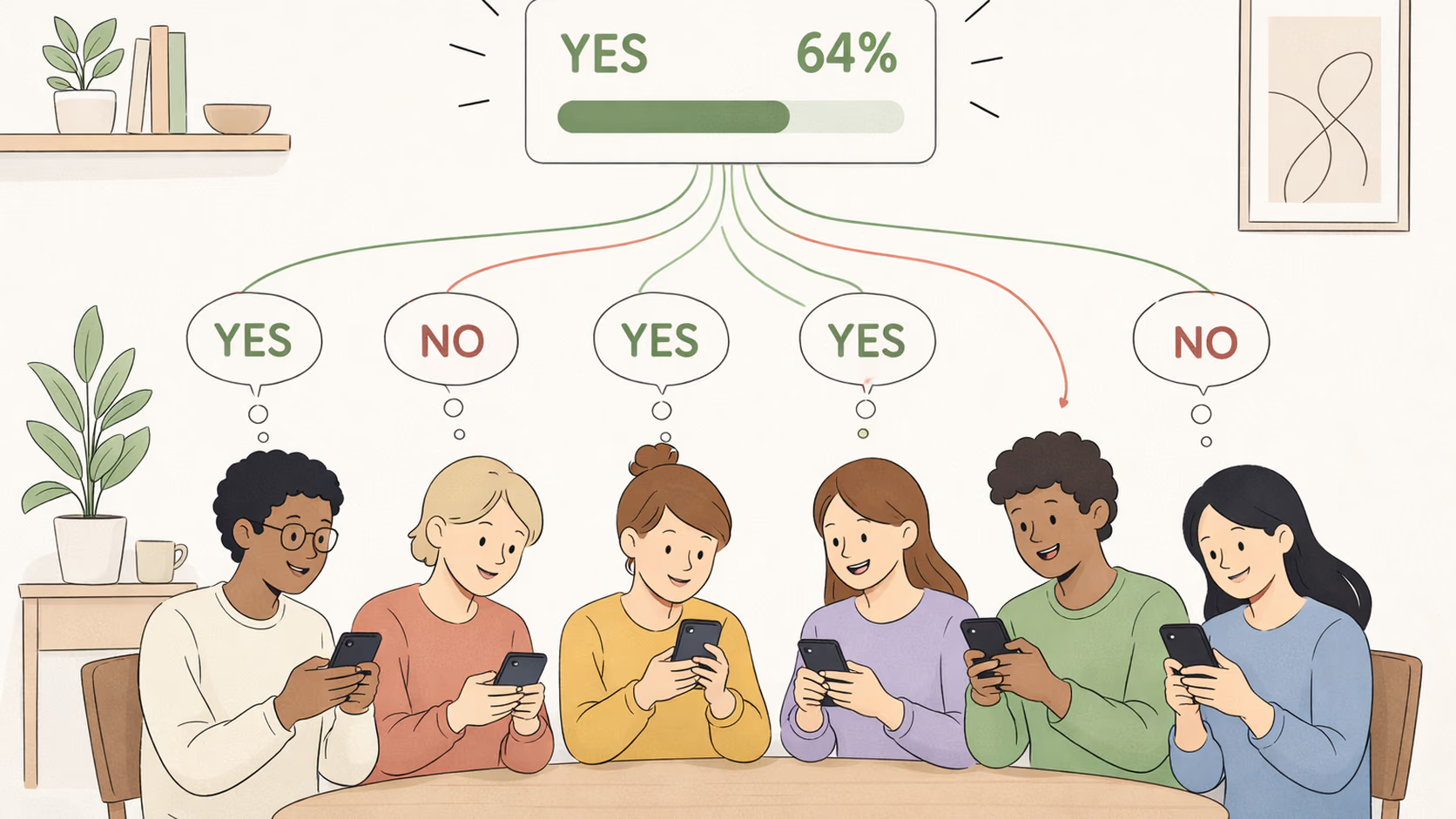
A median is one way to aggregate. A market is another, and in some ways a cleverer one.
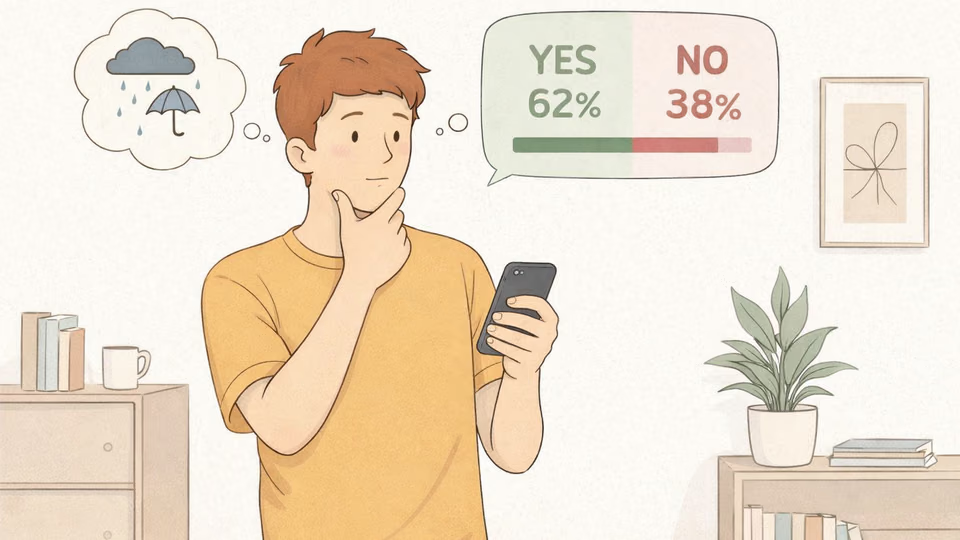
In a prediction market, people buy YES or NO shares in a future event, and the price reads as a probability. If you think the price is too low, you buy YES, which pushes it up. If you think it is too high, you buy NO, which pushes it down. Each purchase is a small piece of information flowing into one number. If you are new to the mechanics, what a prediction market is and how its prices work covers them from the start.
Markets have three features that a plain average lacks:
- Self-selection: people who know something tend to predict more, and people who know nothing can stay out
- Incentive: being wrong shows up in your record, so people think harder before backing a view
- Continuous updating: the number moves whenever new information arrives
The economist Friedrich Hayek made a related point in 1945 in The Use of Knowledge in Society: knowledge in society is scattered, and prices are one way to pool it. Research markets such as the Iowa Electronic Markets have tested the idea on elections, and we compare how that evidence stacks up against polls separately. None of this makes markets infallible. A small, copy-prone market can behave exactly like a herd, which is why the four conditions still apply.
How Do You Build a Wise Crowd With Your Friends?
A group of friends is a small crowd, usually with a lot of shared information: you all follow the same teams and read the same news. That makes independence the condition to protect. Here is a recipe:
- Write a precise question with a clear resolution date and rules, so everyone is guessing about the same thing.
- Collect the first estimate privately, before anyone argues.
- Invite at least one person who sees the topic differently from the group's loudest voice.
- Aggregate with a method you chose beforehand: the median, or a market price.
- Compare the result with what actually happened, and note who was closest over several questions, not just one.
Step one is where most groups slip, and our tips on writing questions that settle cleanly are worth a read before you start.
What about the size of the group? You don't need thousands of people. Albert Kao and Iain Couzin showed that when the information people hold is correlated, which is typical of friends who share the same news feed, a finite and often small group size gives the best decisions, because extra members mostly repeat the same signal (Kao and Couzin, Proceedings of the Royal Society B, 2014). Their models aren't a recipe for your barbecue, but they support the practical point: a few people with different perspectives beat many people with the same one.
If you are choosing between a quick poll and a market in your chat, see when a group chat poll is enough and when a prediction is better.
How Can You Try It on KrowdCall?
Take the barbecue question: "Will at least 30 people come on Saturday?" On KrowdCall you create it as a YES/NO market, set the closing time for the night before, and share the invite link in the group chat. Markets are private by default, so only the people who open that link and sign in with Google can see the price and predict.
Two settings help a small group behave like a better crowd. Choose the fast-moving price sensitivity, so a handful of predictions visibly moves the probability. And watch the Players count on the market page: a probability set by two people is just their opinion, not a crowd.
To protect independence, ask everyone to post their private estimate in the chat before opening the market, then compare it with the price. A live number is useful, but it is also the thing that can cause herding if people just follow it.
When you are ready, create a market, and when you want to sharpen your own estimates after seeing what the group says, the natural next read is habits that make your forecasts better.
So, Is the Crowd Actually Wise?
Sometimes. A crowd is wise under conditions, not by default. It needs different views, independent judgments, local knowledge, and a fair way to combine them. Remove any of those and the crowd is just a louder individual.
That is a useful way to think about your own group, too. The next time your friends argue about an outcome, resist the urge to let the most confident person decide. Collect everyone's number first, then average them and see whether the group beats its best member. Often it will, and when it doesn't, you will have learned something about which condition was missing.
Frequently asked questions
Find quick answers to the most common questions about this topic.
It is the finding that the combined judgment of a large, varied group is often more accurate than most of the individuals in it, sometimes including experts. Francis Galton's 1906 ox-weight contest is the classic example, and James Surowiecki popularized the idea in his 2004 book.

Author
BrumaReady to test your predictions?
Put your foresight to the test. Create your first prediction market in seconds — completely free, with no real money involved.