Prediction Market Glossary: 37 Terms Explained

A prediction market has its own vocabulary, and a few terms, such as YES shares, resolution, and liquidity, come up in every market you join. This glossary explains 37 of the most common prediction market terms in plain English, with short examples and notes on how each one works on KrowdCall.
The terms are grouped by theme, so you can read it from top to bottom as a crash course or jump to the word you need.
Market Basics
Prediction market
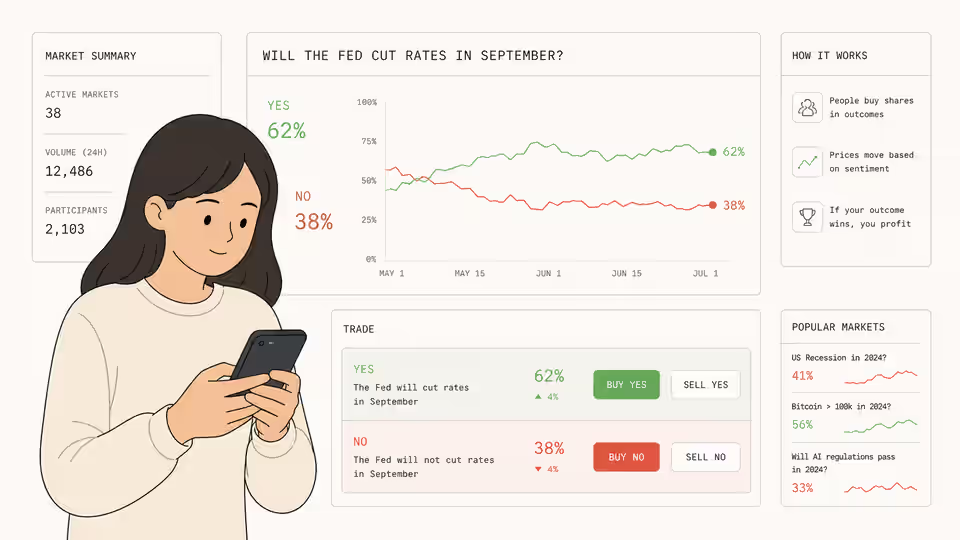
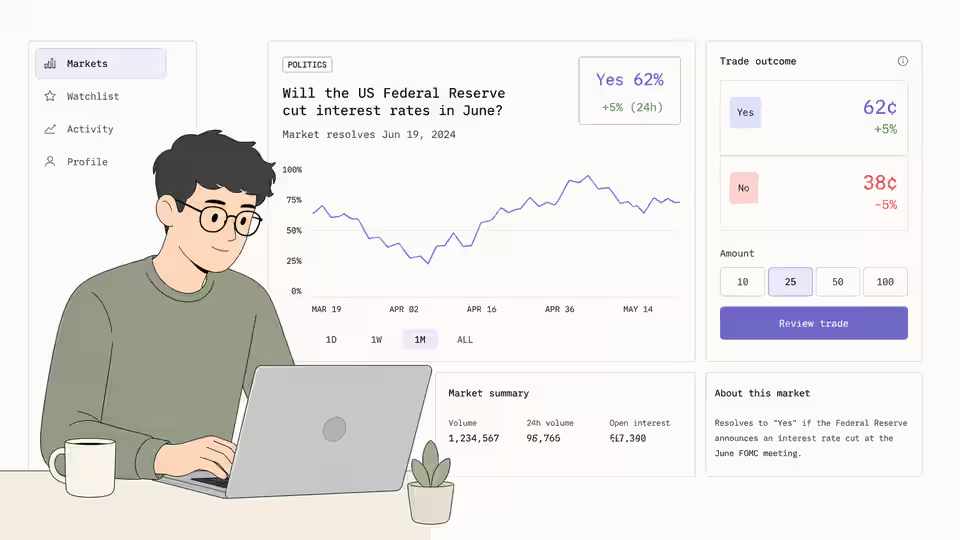
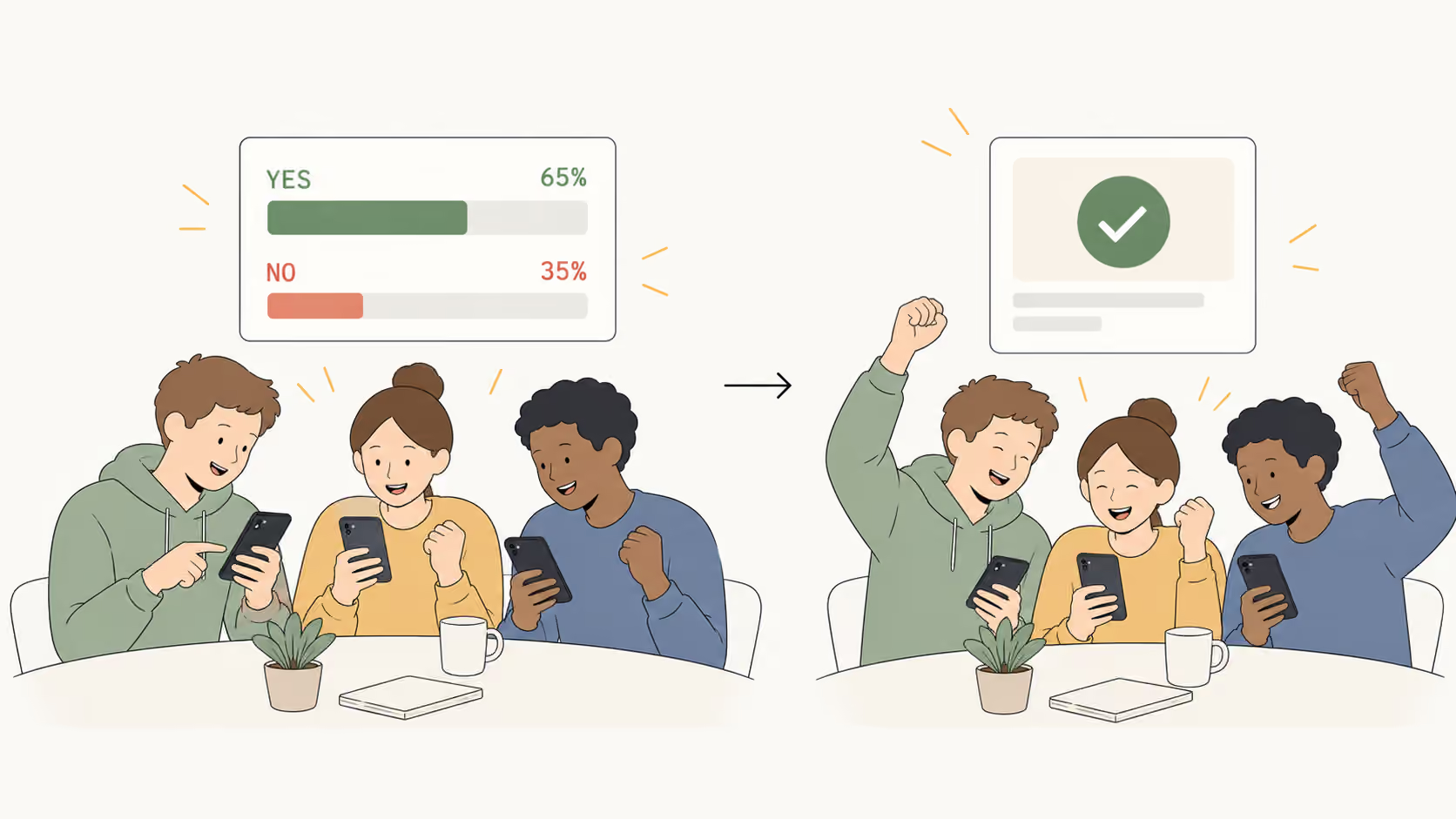
A prediction market is a market where people buy and sell shares on the outcome of a future event, and the share price shows the crowd's estimate of how likely that outcome is. For the full explanation, read What Is a Prediction Market?.
Binary market
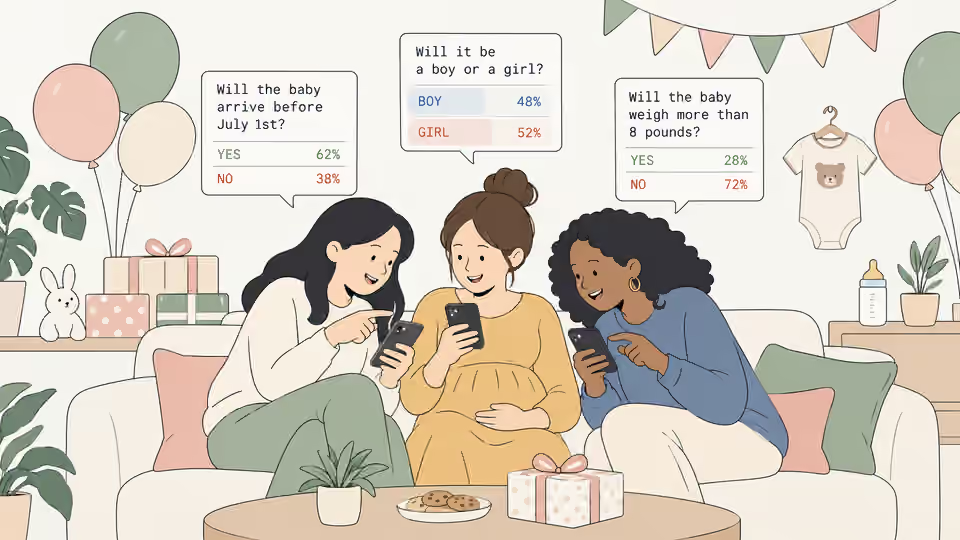
A binary market is a market with exactly two possible outcomes, YES or NO. Every market on KrowdCall is binary, for example: "Will Team A win the final on Saturday?"
Event contract
An event contract is the formal name for a share whose value depends on whether an event happens. The term is mostly used by regulated real-money exchanges.
YES share
A YES share is worth 1 Coin if the event happens and nothing if it does not. If you think a market is too low, you buy YES.
NO share
A NO share is worth 1 Coin if the event does not happen and nothing if it does. If you think a market is too high, you buy NO.
Public market
A public market is a market anyone on the platform can see and predict on. Public markets work best for topics with broad interest, like major sports or elections.
Private market
A private market is a market only invited participants can see and predict on. On KrowdCall, the creator invites 1 to 100 people by username, which makes private markets ideal for friend groups and teams. Private Prediction Markets Explained covers when to use them.
Market creator
The market creator is the person who writes the question, sets the rules and close time, and later resolves the market. How to Create a Prediction Market walks through the job step by step.
Play money
Play money is a virtual currency with no cash value, used to play prediction markets without financial risk. On KrowdCall it is called Coins (ℂ): everyone starts with 1,000, they cannot be bought or cashed out, and on the 1st of every month any balance below 1,000 is topped back up to 1,000.
Prices and Probability
Price
The price of a share is what it costs to buy it right now, expressed between 0 and 1 Coin, or 0% to 100%. On KrowdCall, the price is the probability: a YES price of 0.65 Coins means a 65% chance.
Probability
The probability is the market's current estimate of how likely the event is. A market at 65% YES says the crowd sees roughly a 65% chance of YES.
Implied probability
Implied probability is the probability hidden inside a price. For example, a YES share priced at 0.40 Coins implies a 40% chance that the event happens.
Consensus
The consensus is the view the market price represents: the combined estimate of everyone who has predicted. It can change with every new prediction.
Volume
Volume is the total amount bought and sold in a market. High volume usually means many people have weighed in, which tends to make the price more informative.
Making Predictions
Position
A position is the set of shares you hold in a market, for example 40 YES shares. When the market resolves, each correct share in your position is worth 1 Coin.
Buy and sell
Buying adds shares to your position, and selling returns them to the market maker. Your own sale pushes the price down as you sell, so the average you get per share is a little below the quoted price, and the gap grows with the size of the sale. On KrowdCall, you can sell before the market closes to lock in a gain or cut a loss.
Return
The return is what your shares are worth when the market resolves. Each correct share is worth 1 Coin, and wrong shares are worth nothing.
Price impact
Price impact, sometimes called slippage, is how much your own purchase or sale moves the price. Larger purchases move the price more, so the average price you pay rises as you buy.
PnL (profit and loss)
PnL is how many Coins you have gained or lost across your predictions. On KrowdCall, your P&L page lists your open positions and settled results, which makes it a useful record of how well your calls have held up.
Position sizing
Position sizing is deciding how much to put into a single market. Careful predictors size positions according to their confidence and how much the price moves as they buy, and rarely put their whole balance on one outcome.
Expected value
Expected value is the average result you would get if you made the same prediction many times. If you think YES has a 60% chance and a YES share costs 0.45 Coins, buying YES has positive expected value, at least until your own purchase pushes the price up toward 0.60 Coins.
Edge
Your edge is the difference between your estimate and the market's price. Without an edge, there is no reason to buy. Prediction Market Strategy Guide explains how to find one.
Market Making and Liquidity
Order book
An order book is a list of buy and sell offers waiting to be matched. Many real-money exchanges use one, but it needs a lot of active participants to work well.
Automated market maker
An automated market maker is an algorithm that always quotes a price and takes the other side when you buy or sell. It keeps small markets working, since nobody has to wait for a counterparty.
LMSR
LMSR (Logarithmic Market Scoring Rule) is the automated market maker KrowdCall uses. It raises the price of a side as people buy it and keeps markets liquid even with a handful of predictors. LMSR Explained for Beginners covers how it works, with a worked example.
Liquidity
Liquidity describes how easily you can buy or sell without moving the price much. A liquid market absorbs purchases smoothly, and an illiquid one jumps with every prediction.
Liquidity parameter (b)
The liquidity parameter, written b, is the LMSR setting that controls how much each purchase moves the price. On KrowdCall, the creator picks it through the price sensitivity option when creating a market: Fast-moving (b = 50), Balanced (b = 100) or Stable (b = 200).
Liquidity deposit
The liquidity deposit is the Coins a KrowdCall market creator sets aside to fund the market maker. It equals b × ln 2, the most the market maker can lose. When the market is resolved, the creator gets back the deposit plus the Coins predictors paid in, minus what correct shares are worth (never below 0), so it can come back as more or less than the deposit. If the market is canceled, the whole deposit is returned.
Arbitrage
Arbitrage is locking in a risk-free gain from price differences, for example when the same question sits at different prices in two markets. Arbitrage tends to pull prices back in line.
Resolution

Close time
The close time is when predictions stop. It should be at or before the moment the answer could become known, otherwise late predictors could buy with the answer already visible. On KrowdCall, the creator can move it earlier or later while the market is open.
Resolution
Resolution is the moment the outcome is officially decided as YES or NO. On KrowdCall, the creator resolves the market by hand after it closes, and each correct share is then worth 1 Coin.
Resolution rules
Resolution rules are the written criteria that decide the outcome, including the source and the deadline. On KrowdCall, the description and resolution rules are locked once the first prediction is made, so nobody can change them after people have started predicting. Prediction Market Questions: 9 Writing Tips shows how to write them well.
Cancellation
Cancellation ends a market without a YES or NO outcome, usually because the question became impossible to resolve. On KrowdCall, a market is also canceled automatically if the creator does not resolve it within 7 days after the close time. Predictors get back the Coins they put in, minus what they already took out by selling.
Forecasting Skill
Wisdom of crowds
The wisdom of crowds is the finding that the combined judgment of many people is often more accurate than most of the individuals in it, as long as their judgments are independent and diverse. It works less well when everyone shares the same information or follows the loudest voice. Prediction markets are built to harness it. Prediction Markets vs Polls compares how well markets and surveys capture it.
Calibration
Calibration measures whether your probabilities match reality. If you are well calibrated, the things you call 70% likely happen about 70% of the time.
Brier score
In its common binary form, the Brier score measures forecast accuracy as the average of (probability − outcome)², where YES counts as 1 and NO as 0. Lower is better: 0 is perfect, and always saying 50% scores 0.25.
Base rate
The base rate is how often something like this has happened before. Starting from the base rate, then adjusting for the specifics, is one of the most reliable forecasting habits.
Put the Vocabulary to Work
The fastest way to make these terms stick is to see them in a live market. Sign up for KrowdCall, get 1,000 free Coins, and watch price, probability, and liquidity interact as people make predictions.
New to all of this? Start with What Is a Prediction Market?, then browse the live markets to make your first prediction.
Frequently asked questions
Find quick answers to the most common questions about this topic.
It means the market currently estimates a 70% chance that the event will happen. A YES share costs about 0.70 Coins and is worth 1 Coin if the answer is YES, so the price works as both a cost and a probability.

Author
Bruma