Prediction Markets vs Sports Betting: Key Differences
Prediction markets and sports betting both put a price on outcomes, but who takes the other side, how prices are set, and the rules differ. Here is how.
- Author
 Bruma
- Published
- Reading time
- 7 min
- Category
- Comparisons
In short
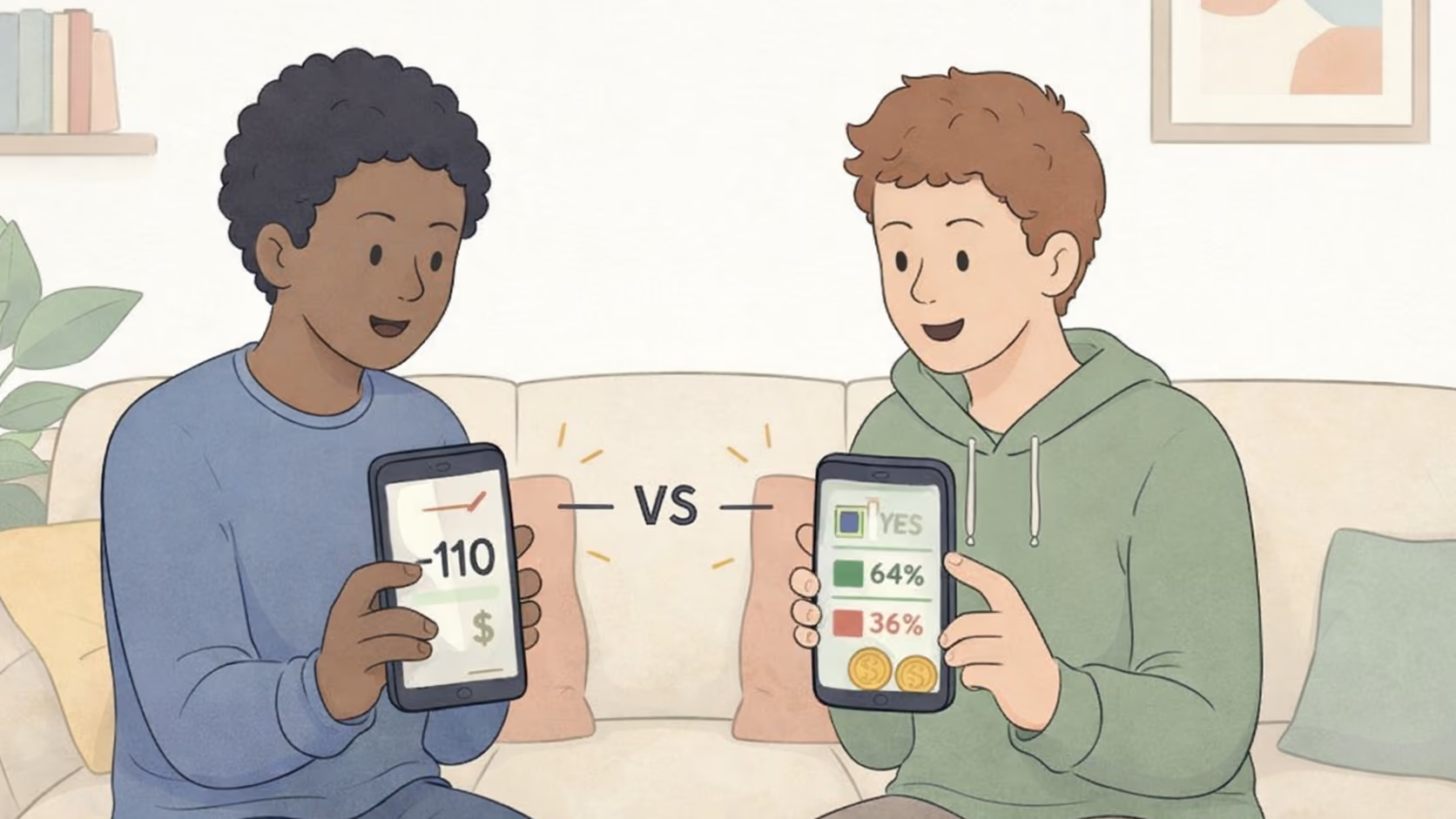
In sports betting you bet against a bookmaker who sets odds with a built-in margin. In a prediction market you trade YES/NO shares whose price is a probability, set by other traders or an automated market maker. Markets also cover non-sports questions, and the rules for both vary by country.
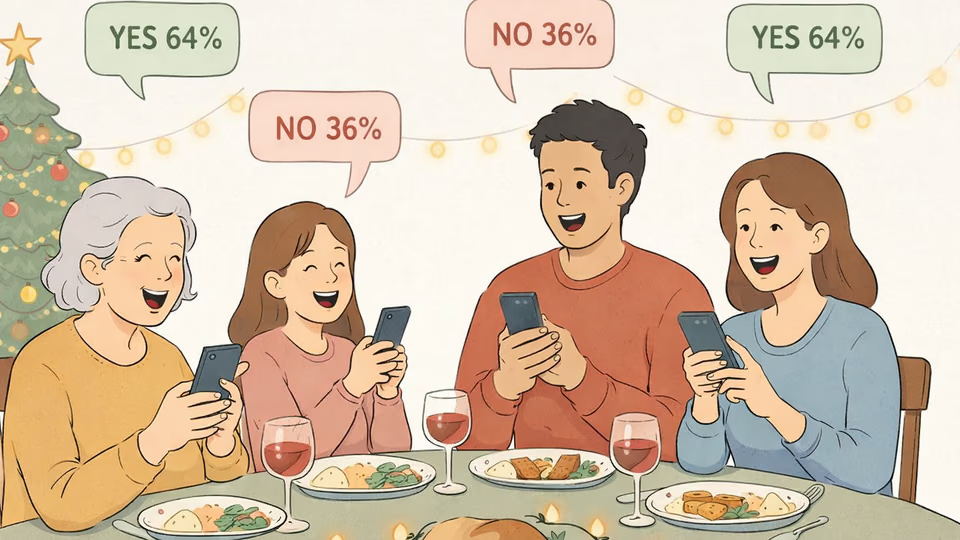
You open a sports app and see "Team A: 1.80." You open a prediction market and see "Team A wins: 56%." Both describe the same match, and both let you take a side. So are prediction markets just sports betting with a nicer coat of paint?
Not quite. Sports betting is a wager on a sporting event placed with a bookmaker (a sportsbook) that publishes odds, takes the other side and pays out if you are right. A prediction market is a market where people trade shares in the outcome of a future event, usually a YES/NO question, and the share price reads as the crowd's probability. We will go through who sets the price, how the bookmaker's margin works, what each can cover, how the rules differ, and where a free play-money market like KrowdCall fits.
What Is the Difference Between a Prediction Market and Sports Betting?
The simplest test is to ask who sets the price. At a sportsbook, the bookmaker does: its traders and models pick a line, adjust it as bets arrive and keep a margin. In a prediction market, the price is a by-product of trading. If more people want YES, the YES price rises. (If the basics are new, what a prediction market is covers them first.)
| Sports betting | Prediction markets | |
|---|---|---|
| Who takes the other side | Usually the bookmaker | Other traders or an automated market maker |
| Who sets the price | The bookmaker, as odds | Trading activity, shown as a probability |
| Built-in margin | Yes, the vig or overround | Not in the YES/NO prices themselves; fees and spreads vary by platform |
| Can you sell before the end | Sometimes, through cash-out offers | Typically yes, while the market is open |
| What you can ask about | Mostly sport and some entertainment | Almost any clearly resolvable future event |
| Main purpose | Entertainment and wagering | Forecasting and information aggregation |
| Rules | Licensed gambling regulation in most places | Varies widely by country and platform |
The rest of this post unpacks each row.
Who Is on the Other Side of Your Trade?
At a sportsbook, the counterparty is almost always the sportsbook. You win, it pays you; you lose, it keeps your stake. That is why bookmakers manage their exposure closely and why accounts that win consistently can be limited.
In a prediction market there are two common designs.
- An exchange or order book: you buy YES at a price someone else is willing to sell at, so the counterparty is another trader.
- An automated market maker: a pricing algorithm quotes a price for YES and NO at all times and takes the other side of every trade.
KrowdCall uses the second design, with a rule called LMSR (Logarithmic Market Scoring Rule). The market maker is always ready to buy or sell, so a small group can trade even when only two people are online. The YES and NO prices always add up to 1 Coin (100%). The math is in how LMSR pricing works, step by step.
Wait, doesn't an automated market maker sound like a house? The important distinction is that the algorithm isn't trying to earn a margin. Its worst-case loss is capped and covered by a deposit from the market's creator, who gets that deposit back adjusted by how the market maker came out, so the creator can end up with a little more or a little less. The price moves only because people predict. It is a pricing tool, not a bookmaker with an edge.
How Do Prices and the Bookmaker's Margin Work?
Sportsbook odds contain a margin, usually called the vigorish (vig or juice): the fee a bookmaker earns for accepting a wager, as the Wikipedia article on vigorish puts it.
Here is a worked example. In a two-way line of -110 on both sides, you risk 110 to win 100. Your break-even win rate is 110 / 210 = 52.38%. Both sides imply 52.38%, so the two implied probabilities add up to 104.76%. That extra 4.76% is the overround, the amount by which implied probabilities exceed 100%, and it is how the bookmaker gets paid even without an opinion about the game.
Now compare a prediction market. If the YES price is 0.56, the NO price is 0.44. They add up to exactly 1, so there is no overround hiding in the pair. (How to convert market prices into decimal and American odds lets you compare the two side by side.)
Okay, but it isn't free everywhere. Real-money prediction market platforms may charge trading fees, and an exchange can show a gap between the best buy and sell prices, which works like a cost. So the honest comparison is not "betting has a margin, markets don't." Betting builds the margin into the odds, while markets show a clean probability and handle costs separately, in ways that depend on the platform.
What Can You Predict in Each?
A sportsbook offers a menu of match results, totals, player props and futures, chosen by the bookmaker and mostly about sport. A prediction market can host any question with a clear outcome by a clear date, and platforms usually list politics, economics, science and entertainment next to sports. On KrowdCall, anyone can write a question, pick a category, set a closing time and write the resolution rules.
That openness changes what the tool is good for. A friend group can ask:
- Will our team win the league this season?
- Will the new office coffee machine be installed before 1 March?
- Will it rain on the day of the barbecue?
- Will the film we are watching on Friday score above 80% on Rotten Tomatoes?
None of those would appear on a sportsbook menu. Questions like these also decide how good a market is, so how to write a question that resolves cleanly is worth reading before you create one.
What Is the Goal: Winning Money or Measuring Beliefs?
A sportsbook exists to take wagers; a prediction market exists to produce a number. Where money is involved, it is the incentive that makes people reveal what they know.
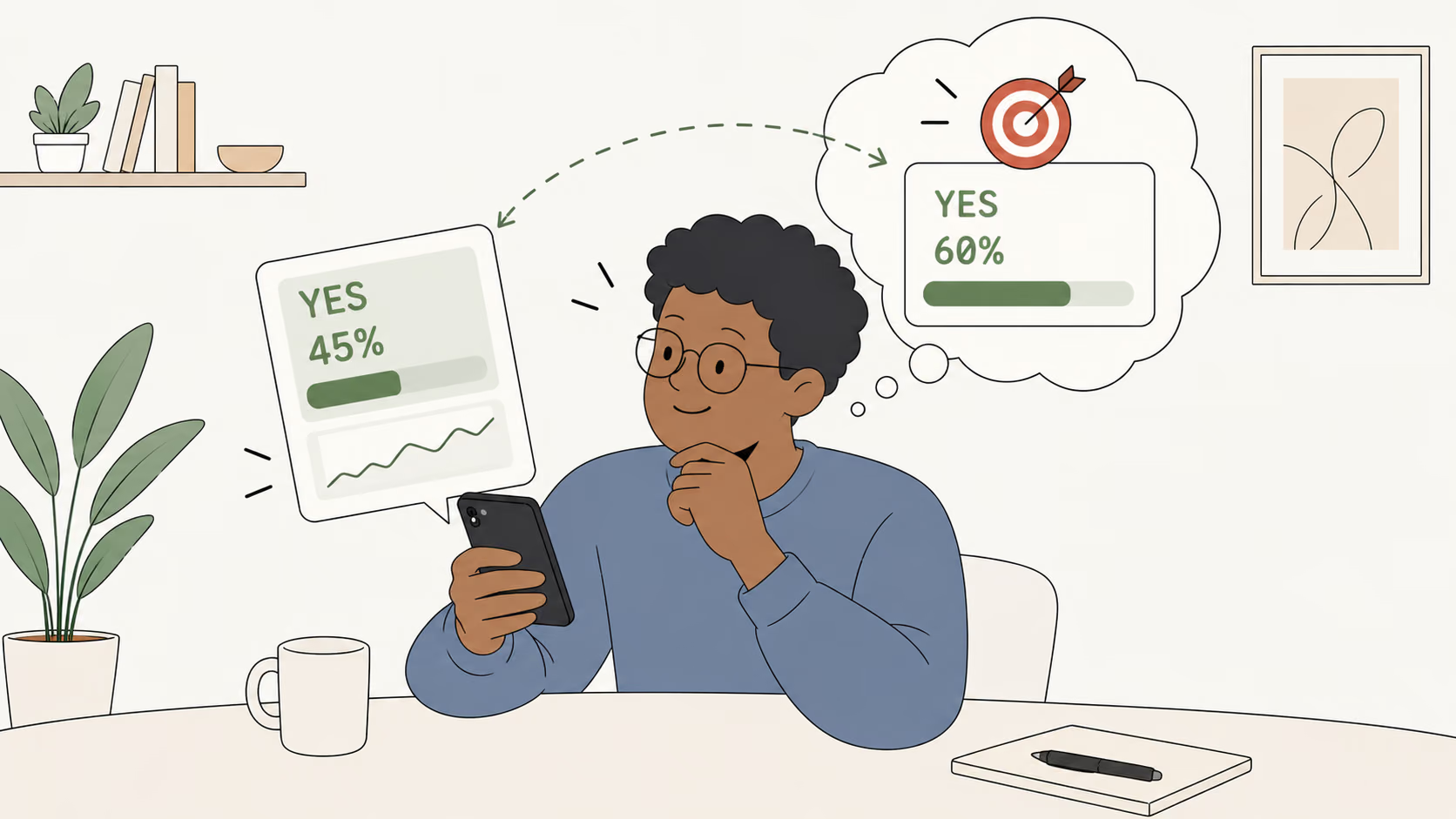
That is why researchers study markets such as the Iowa Electronic Markets: they are a way of combining scattered information. How market forecasts compare with polls looks at the evidence, and why the average of many guesses is often surprisingly good explains the reasoning.
It is also a difference in mindset. Betting invites you to pick a game and back a side. Forecasting asks a more uncomfortable question: is the probability on screen higher or lower than my honest estimate, and why? Even in a casual friend group, that second question tends to produce better conversation.
Are Prediction Markets Legal, and How Is Sports Betting Regulated?
It depends on where you live, and this section is general information, not legal advice.
Sports betting is regulated as gambling in most places that allow it. In the United States each state decides whether to license sportsbooks, and in many other countries a national licensing body decides.
Prediction markets sit in a less settled area. In the US, some platforms operate as exchanges overseen by the Commodity Futures Trading Commission (CFTC); Kalshi, for example, announced CFTC approval as a designated contract market in 2020. Sports-related contracts in particular have been contested: the CFTC has asked the public for comment on prediction market rules and has gone to court over whether states can regulate them. Both pages are from 2026, and the situation may have moved since, so check current sources. Outside the US, event contracts are treated differently from country to country: as gambling in some places, as financial products in others, and with no clear rule in some.
In practice, that means three things:
- Check the rules where you live before you put real money into any betting or trading product.
- Don't assume that a platform being available to you means it is permitted for you.
- If you only want the fun and the forecasting, use a platform that involves no money at all.
Where Does Each One Go Wrong?
Both can lose you money or mislead you, but in different ways.
Costs you can't see. A sportsbook's cost is the margin inside the odds, and over many wagers the average bettor loses to it. A real-money prediction market's cost sits in fees and the gap between buy and sell prices, and in thin markets one confident trader can move the price.
Who writes the rules. A sportsbook's house rules decide edge cases, such as whether a match decided on penalties counts as a win. In a prediction market, the question's author writes the resolution rules, and vague ones are the main source of arguments. Whether extra time or a shootout counts needs to be in the question.
Reading 56% as a fact. A price is a group's best guess, not knowledge. A market with a handful of participants is often wrong, because there isn't enough independent information in it.
Compulsive use. Fast, always-on apps with real money can encourage chasing losses. If gambling stops being fun, support organizations in your country can help, and many operators offer self-exclusion tools.
Where Do Free Play-Money Markets Like KrowdCall Fit?
A free market keeps the useful part, the live probability and the friendly rivalry, and drops the money. On KrowdCall, Coins can't be bought or sold and have no real-world value, and a market's creator resolves it after it closes, so there are no payments to chase and nothing to negotiate. How that works, and what play money can and can't do, is in what virtual Coins are and where they fall short.
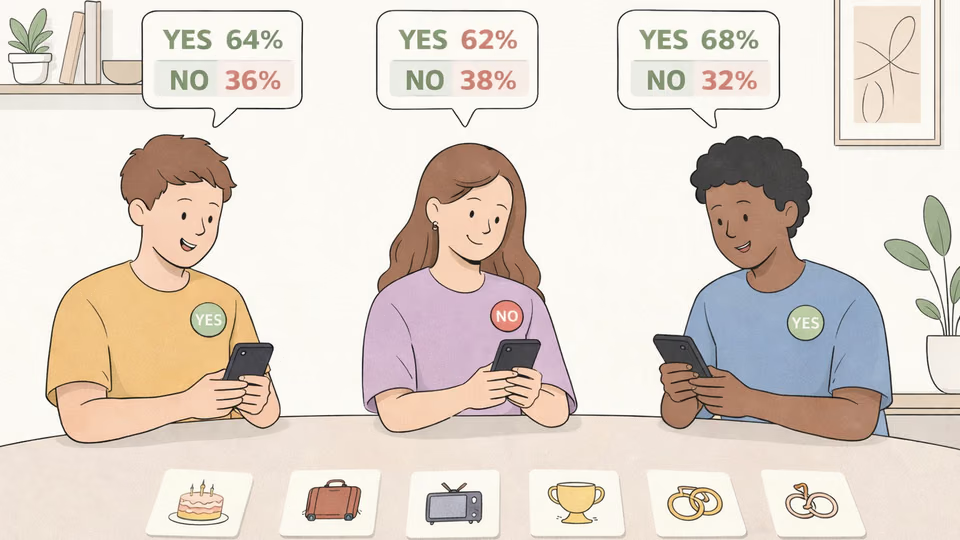
It suits people who like sports but not gambling, and it gives a group something a heated argument doesn't: a timestamped record of what each person predicted and at what price. If you want other options, free prediction market apps compared covers several, and sports predictions for friends has match-day ideas.
So Which One Should You Use?
It comes down to what you want out of it.
If you want to wager real money on a game and that is legal and licensed where you live, a regulated sportsbook is the product built for it, as long as you understand that the odds include a margin.
If you want to know what a group thinks will happen, on sport or anything else, a prediction market is the better tool, because the price is a probability and the question can be about anything resolvable.
If you want the forecasting without the money, a play-money market is the easiest place to start. Pick a match this weekend, create a market and share its invite link in your group chat, then watch how the number moves. You can also browse open markets first to see how others phrase their questions.
Frequently asked questions
Find quick answers to the most common questions about this topic.
No, although they overlap. A sportsbook sets odds and takes your bet itself, with a margin built in. A prediction market lists YES/NO shares priced as probabilities, and you trade them with other people or an automated market maker. Markets can also cover politics, science, or office questions, not just games.

Author
BrumaReady to test your predictions?
Put your foresight to the test. Create your first prediction market in seconds — completely free, with no real money involved.